Free CDL Combination Practice Test 2026: The Ultimate Study Guide
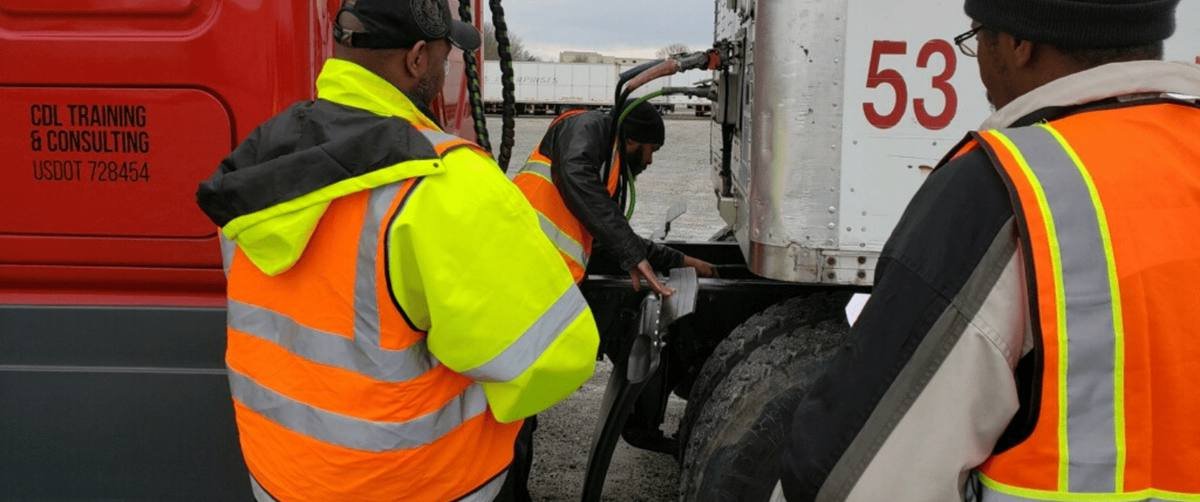
Don't just read the guide. Test yourself with the actual questions likely to appear on your CDL test.
If you want a Class A CDL, you must pass the Combination Vehicles endorsement test. This exam covers the unique skills needed to drive tractor-trailers safely, including coupling, uncoupling, and rollover prevention.
Unlike the General Knowledge test, this section focuses heavily on physics and procedure. This guide breaks down the hardest concepts, helping you understand why things happen on the road, not just memorizing answers.
1. Preventing Rollovers & The "Crack the Whip" Effect
Combination vehicles are top-heavy and unstable. The most important rule to prevent rollovers is to steer gently.
What is "Crack the Whip"?
When you make a quick lane change, the rear trailer amplifies your movement. If you move the tractor a little, the trailer moves a lot. This can flip the trailer over even if the tractor stays upright. The rear-most trailer is always the most likely to roll over.
Comparison: Tractor-Trailer vs. Straight Truck
Why is driving a combination vehicle so much harder? Let's look at the physics.
| Feature | Straight Truck (Class B) | Combination (Class A) |
|---|---|---|
| Braking Distance | Standard | Longer (Brake Lag) |
| Rollover Risk | Moderate | High (Rearward Amplification) |
| Off-Tracking | Minimal | Severe (Cheating) |
| Jackknife Risk | Low | High (Tractor & Trailer) |
2. Off-Tracking (Cheating Turns)
When a vehicle goes around a corner, the rear wheels follow a different path than the front wheels. This is called off-tracking or "cheating".
The longer the vehicle, the more off-tracking occurs. The rear wheels of the trailer will track much closer to the curb than the tractor's wheels. To compensate, you must steer wide as you complete the turn, not at the beginning.
3. Braking with Trailers
Do not use the Trailer Hand Valve while driving. It should only be used to test the trailer brakes. Using it while moving can cause the trailer wheels to lock up and skid, leading to a jackknife.
When the wheels of a trailer lock up, the trailer tends to swing around. This is known as a Trailer Jackknife. If this happens, your only hope is to release the brakes immediately to let the tires grip the road again.
Real-World Scenario: The "Empty Trailer" Danger
The Scenario: You are driving a tractor-trailer on a highway. It is a windy day, and you have just delivered your load, so your trailer is empty.
The Risk: Many new drivers think an empty truck stops faster. This is WRONG.
- Braking: Empty trucks take longer to stop than loaded trucks because there is less weight pushing the tires into the road (less traction).
- Wind: An empty trailer is like a giant sail. Strong winds can flip an empty trailer easily or push it into another lane.
- Bounce: Without weight, the suspension is stiff. The trailer may bounce on bumps, locking up wheels and causing a jackknife.
Exam Tip: If a question asks about stopping distance for empty trucks, the answer is almost always "Longer".
4. The Critical Coupling Sequence
You will definitely see questions about the correct order of coupling. Here is the golden rule sequence you must memorize:
- Inspect the Fifth Wheel & Air Lines.
- Position the Tractor directly in front of the trailer.
- Back slowly until the Fifth Wheel touches the Trailer Apron.
- SECURE THE TRACTOR (Parking Brake).
- Connect Air Lines (Red to Red, Blue to Blue) and Electrical Cable.
- Supply air to trailer and check brakes.
- Back under the trailer until the Kingpin locks.
- Perform a Tug Test (pull forward gently).
- Visually check the locking jaws.
- Raise Landing Gear fully.
5. Air Brake Lines Explained
Combination vehicles have two air lines connecting the tractor and trailer. You must know them by color and function:
- Service Line (Blue): Controls the service brakes. When you press the pedal, air flows through here to stop the trailer.
- Emergency Line (Red): Supplies air to the trailer tanks and controls the emergency brakes. If this line breaks, the trailer emergency brakes come on immediately.
3 Common Mistakes That Fail The Road Test
Knowing the book answers is one thing; driving is another. Here is where students fail the skills test for Combination Vehicles:
Forgetting the Landing Gear
If you try to drive off without fully raising the landing gear, it will catch on railroad tracks or uneven ground. Instant fail.
Crossing Air Lines
Connecting Red to Blue and Blue to Red. Always check the colors (or tags) on the glad hands. Cross-connecting means no brakes.
Visual Check of the Kingpin
During the pre-trip, you must physically crawl under the trailer (or use a flashlight) to verify the locking jaws are closed around the kingpin shank. Assuming it's locked by sound is not enough.
Free Combination Vehicles Practice Quiz (Sample)
Here are 5 critical questions that appear on almost every exam.
Pass the Class A Exam First Try
The real exam has 50-70 questions. Our app covers every possible scenario, including Pre-Trip Inspection and Air Brakes.
Unlock Full Simulator