California CDL Handbook 2026: DL 650 PDF & CHP Rules
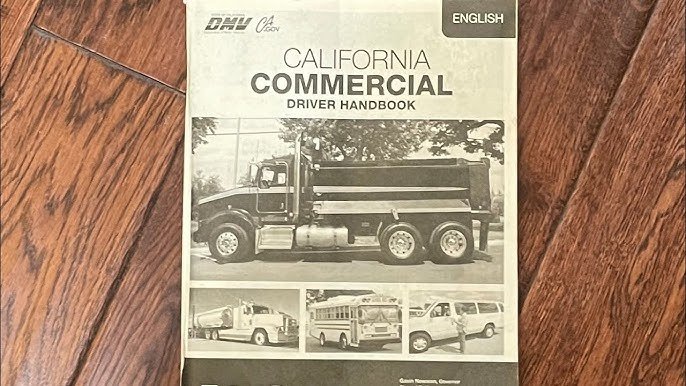
The California CDL Handbook (officially called Form DL 650) is the document you need to study if you want to drive a truck in the Golden State. Not some generic trucking guide from Amazon. This one.
California does not just copy the federal manual and call it a day. The state has its own emissions agency (CARB), its own highway patrol enforcement division (CHP), and its own set of trucking laws that are stricter than almost anywhere else in the country. If you study a generic CDL book and walk into a California DMV, you will get hit with questions about bridge weight formulas and idling restrictions that your study guide never mentioned.
This guide breaks down the California CDL Handbook section by section. We will tell you what to read, what to skip, and what California-specific rules will show up on your test.
Download the Official DL 650 PDF
Do not trust third-party PDFs. They are often outdated and missing the latest CARB regulation updates.
- Download California CDL Handbook (PDF) — This is the official DMV link.
- California also offers an HTML version on their site, but the PDF is better for offline study. Save it to your phone or tablet so you can read it anywhere.
The manual is updated roughly once a year. Make sure the version you are reading says 2025 or 2026. If it says 2023 or earlier, download the new one.
California-Specific Laws You Will Be Tested On
This is where the California CDL Handbook separates itself from the federal material. These topics are tested on the General Knowledge exam, and most out-of-state practice apps do not cover them.
The 55 MPH Speed Limit
California has a hard cap on truck speed that most new drivers do not know about until they get pulled over.
- The rule: Any vehicle towing a trailer, and any truck with three or more axles, is limited to 55 mph on all highways. This includes interstates. It does not matter if the posted limit is 65 or 70. You are capped at 55.
- Lane restriction: Vehicles subject to the 55 mph limit must also drive in the rightmost lanes. On a four-lane freeway, you stay in the two right lanes. The left lanes are off limits.
- On the test: You will see questions about stopping distances calculated at 55 mph, not 65. The California CDL Handbook uses 55 mph as the baseline for all distance calculations because that is your legal maximum.
This is not a suggestion. CHP enforces it aggressively, especially on I-5 through the Central Valley and the Grapevine on I-5 near Tejon Pass.
CARB Idling Restrictions
The California Air Resources Board (CARB) is the reason California has the strictest diesel emissions rules in the country. The California CDL Handbook covers these in detail.
- The 5-minute rule: Commercial diesel vehicles cannot idle for more than 5 minutes within 100 feet of a residential area.
- Fines: Starting at $300 per violation. If you are caught idling at the Ports of Los Angeles or Long Beach, the fine can jump to $1,000 or more.
- Exceptions: You can idle if the ambient temperature is below 32°F or above 90°F and you need the climate control for safety. Some trucks with "Clean Idle" certified engines (emitting less than 30 g/hr of NOx) get a longer window.
- On the test: Expect a question like "How long can you idle a diesel truck near a California residential area?" The answer is 5 minutes.
The Kingpin-to-Rear-Axle (KPRA) Rule
California has a unique dimensional restriction for semi-trailers that most other states do not enforce.
- The rule: The distance from the kingpin (the pin on the trailer that locks into the fifth wheel) to the center of the rear axle must not exceed 40 feet on a 53-foot trailer.
- Why it exists: When a long trailer takes a tight corner, the rear of the trailer swings wide (off-tracking). On California's older interchanges and tight urban ramps, this causes trucks to clip barriers, signs, and other vehicles. The 40-foot limit reduces that swing.
- On the test: You may see a diagram showing a trailer with measurements. Know the 40-foot number and understand that it is measured from the kingpin, not from the front of the trailer.
Bridge Weight Formulas
California uses federal bridge weight formulas but applies them more aggressively due to the state's aging bridge infrastructure. The handbook includes a section explaining how to calculate allowable weight based on axle spacing. You do not need to memorize the full formula, but you need to know:
- Closer axle spacing = lower weight limit
- More axles = higher weight limit
- The maximum gross weight for a standard 5-axle semi in California is 80,000 lbs on interstate highways
The CHP Inspection Standard
The California CDL Handbook explains that the Vehicle Inspection test (Section 11) in California is often administered at CDL Testing Centers (CDTCs) where California Highway Patrol officers may be present or involved.
California has adopted the AAMVA Modernized Skills Test at many locations. This means:
- The pre-trip checklist is shorter, focusing on Critical Safety Items rather than naming every component
- You must physically point to or touch each item and describe what you are checking
- Automatic fail items: Forgetting the air compressor belt check, or failing to properly demonstrate the air brake leak-down test
The manual provides the exact script for the air brake test. Memorize it word for word. The examiner expects you to say the PSI numbers out loud as you perform each step.
California CDL Fees (2026)
The California CDL Handbook lists state fees, but the real cost includes third-party testing. Here is the breakdown:
| Item | Cost |
|---|---|
| CLP (Commercial Learner's Permit) | $93 (includes knowledge test) |
| Class A CDL (5-year) | $93 |
| Endorsement (each) | $9 |
| Skills Test (Third Party) | $150 - $350 |
| DOT Physical | $75 - $200 |
| HazMat Background Check (TSA) | $86.50 |
California charges more than most states for the license itself, but the knowledge test is included in the permit fee. The big variable is the third-party skills test, which varies by location. Calling around to compare prices is worth the effort.
What to Skip
Unless you need these specific endorsements, skip these sections to save time:
- Section 4 (Passengers) — Bus drivers only
- Section 10 (School Buses) — Separate endorsement entirely
- Section 13 (Passenger Road Test) — Not relevant for Class A
- Firefighter Endorsement — Only if you are applying to Cal Fire or a municipal department
Focus your study time on Section 2 (Driving Safely), Section 5 (Air Brakes), Section 6 (Combination Vehicles), and Sections 11-13 (Skills Test). These cover roughly 85% of what you will be tested on.
California Practice Questions (Handbook Based)
California law caps trucks with three or more axles and all vehicles towing trailers at 55 mph, regardless of the posted speed limit. This is enforced by CHP and tested on the California CDL exam. The posted 70 mph limit applies to passenger vehicles only.
CARB regulations prohibit idling a commercial diesel vehicle for more than 5 minutes within 100 feet of a residential area. The temperature exception only applies when it is below 32°F or above 90°F, and only for driver safety — not comfort.
California's kingpin-to-rear-axle (KPRA) limit is 40 feet, which is stricter than the federal standard. At 42 feet, this trailer configuration is illegal in California. The restriction exists to reduce off-tracking on the state's tight highway ramps and interchanges.
General Knowledge
The #1 starting point. Covers vehicle inspections & basic road safety rules.
Conclusion
The California CDL Handbook is not something you can wing. Between the 55 mph speed cap, CARB idling rules, the 40-foot KPRA limit, and CHP inspection standards, California tests material that generic study guides completely skip. Download the DL 650, read Sections 2, 5, 6, and 11-13, and pay extra attention to the California-specific chapters covered above.
Test yourself with our Free CDL Practice Test to see where you stand. For California-specific questions, check our California CDL Practice Test guide.
Frequently Asked Questions (FAQ)
Where can I download the California CDL Handbook?
Download it directly from the CA DMV website at dmv.ca.gov. Search for "DL 650" or navigate to the Commercial Driver Handbook page. The PDF is free and updated annually. Do not use third-party copies — they may be missing the latest CARB and CHP regulation updates.
Does the California CDL Handbook cover the 55 mph speed limit?
Yes. The manual states that any vehicle towing a trailer, or any truck with three or more axles, is limited to 55 mph on all California highways. This includes interstates where the posted limit is higher. The handbook uses 55 mph as the baseline for all stopping distance calculations.
What is the CARB idling rule in California?
CARB prohibits commercial diesel vehicles from idling for more than 5 minutes within 100 feet of a residential area. Fines start at $300 per violation and can exceed $1,000 at port facilities. Exceptions exist for extreme temperatures (below 32°F or above 90°F) when climate control is needed for driver safety.
Can I take the California CDL permit test in Spanish?
Yes. The California DMV offers the written knowledge tests in Spanish at most field offices. The DL 650 handbook itself is also available in Spanish (Form DL 650 S). However, the skills and road tests must be conducted entirely in English.
What is the kingpin-to-rear-axle limit in California?
California limits the distance from the kingpin to the center of the rear axle to 40 feet on semitrailers. This is stricter than federal standards and is designed to reduce trailer off-tracking on tight highway curves and urban interchanges.
How much does a CDL cost in California?
A Class A CDL in California costs $93 for a 5-year license. The Commercial Learner's Permit (CLP) is also $93 and includes the knowledge test fee. Third-party skills tests run an additional $150-$350 depending on the testing location and truck rental fees.
Explore More Practice Tests
General Knowledge
The #1 starting point. Covers vehicle inspections & basic road safety rules.
HazMat (H)
Master the placarding tables, shipping papers, and TSA requirements.
Air Brakes (L)
Memorize critical PSI numbers and the 3-step L.A.B. check process.
Combination
Learn the 5-step coupling checklist and rollover prevention techniques.
Pass Your CDL Exam First Try
Don't guess. Practice with 1000+ real exam questions updated for 2026.
Start Free Practice