You have been studying for your CDL permit test for two weeks. You have done the General Knowledge section four times. Air Brakes twice. Combination Vehicles once. You are scoring 85% on each individual test.
Then you sit down at the DMV computer and the first question is about Air Brakes. The second one is General Knowledge. The third is Combination. They are all mixed together. The timer is counting down. You freeze because you have never practiced this way.
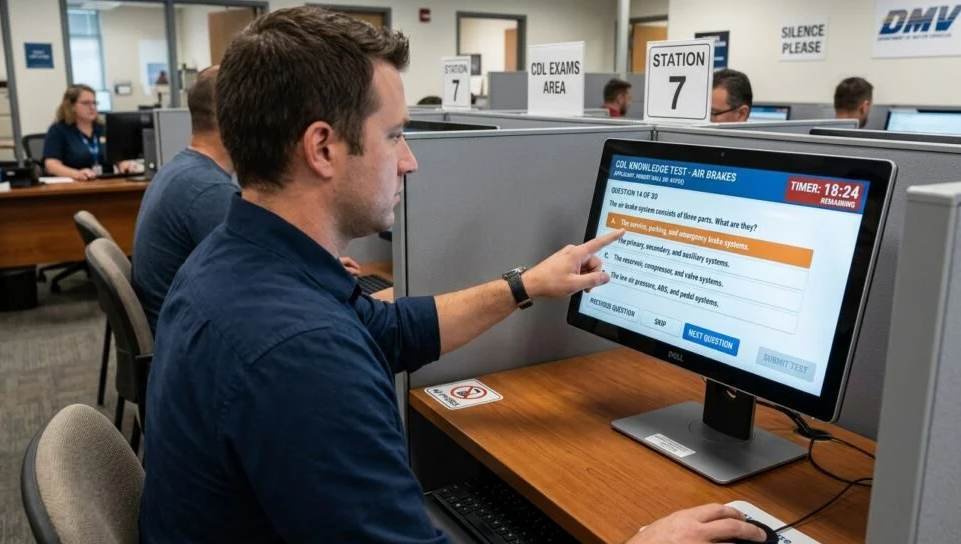
This is the gap between passing practice tests and passing the real exam. Single-subject practice tests teach you the material. A CDL mock test teaches you how to survive the actual testing environment.
A proper mock exam throws all three core subjects at you in random order, under a time limit, with no section labels or hints about which topic each question belongs to. That is exactly what the DMV does. If you have never experienced that mixture before test day, the format alone will cost you points.
This guide gives you a 75-question timed pretest for CDL permit preparation, explains the strategy for taking mock exams, and tells you exactly what score you need before booking your DMV appointment.
Why a CDL Mock Test Is Different from Regular Practice
Most cdl exam prep tools let you pick one subject at a time. “I want to study Air Brakes.” You answer 20 Air Brakes questions, get your score, and move on.
The DMV does not work like that.
When you sit down at the testing computer, you take each exam separately (General Knowledge, then Air Brakes, then Combination Vehicles), but the questions within each exam are shuffled from a large pool. You might get three straight Air Brakes questions about leak test values, then jump to a question about following distance, then back to slack adjusters.
A cdl mock test replicates this randomness. It forces your brain to switch gears between subjects without warning. That cognitive switching is where people lose points - not because they do not know the answer, but because it takes their brain a second to remember which set of rules applies.
If your only cdl exam prep has been single-subject quizzes, you are trained for the wrong format.
The 75-Question Pretest for CDL Permit
This pretest pulls from all three core subjects. Set a timer for 60 minutes. Do not pause. Do not look up answers. Answer every question from memory, then check your results at the end.
General Knowledge (Questions 1-35)
50 feet / 10 = 5 seconds base. Speed is over 40 mph, so add 1 second. Total = 6 seconds.
Check mirrors every 5-8 seconds. The 12-15 second number is how far ahead you should look down the road, not mirror check frequency.
Release the accelerator and disengage the clutch. Do not brake. Do not jerk the wheel. Let the tires regain traction naturally.
When backing, the trailer moves opposite to the steering wheel. Turn left to send the trailer right. This is counterintuitive and is why backing maneuvers have such a high failure rate.
Front tires require at least 4/32-inch tread depth. All other tires need 2/32 inch. This is a specific number the DMV will test you on.
Air Brakes (Questions 36-55)
Governor cut-out (compressor stops) is around 125 psi. Cut-in (compressor starts again) is around 100 psi. If the system somehow exceeds 150 psi, the safety relief valve opens.
Combination vehicle applied leak test: 4 psi/min. Straight truck applied: 3 psi/min. Combination static: 3 psi/min. Straight truck static: 2 psi/min. Know all four values.
The warning buzzer and light must trigger before 60 psi. If you see or hear it while driving, you have a serious leak. Pull over immediately.
Combination Vehicles (Questions 56-75)
The tractor protection valve detects the pressure drop and snaps shut, keeping remaining air in the tractor so you can still steer and brake to a stop.
A trailer jackknife happens when the trailer wheels lock (usually under heavy braking with an empty or light trailer) and the trailer swings around, pushing against the back of the tractor. Empty trailers are especially vulnerable because they have less traction.
Before connecting anything, visually confirm the locking jaws are fully closed around the kingpin and there is no gap between the trailer apron and the fifth wheel. Only after this visual check should you connect air lines and do a tug test.
How to Score This Mock Test
Count your correct answers out of 11 sample questions above, then use this scale to estimate your readiness for the full 95-question DMV exam:
| Score | Readiness | What to Do |
|---|---|---|
| 90-100% | Ready | Book your DMV appointment |
| 80-89% | Almost | Review wrong answers, retake in 2 days |
| 70-79% | Not yet | Focus cdl exam prep on your weakest subject |
| Below 70% | Need work | Re-read the manual sections before more testing |
The DMV passing threshold is 80%. But on your pretest for CDL permit preparation, you should aim for 85% or higher. The real exam adds nerves, noise, and time pressure that your practice sessions do not have. That extra 5% is your safety margin.
The CDL Exam Prep Strategy: How to Use Mock Tests
Taking a cdl mock test once is not enough. Here is the four-round strategy that gets results.
Round 1: The Diagnostic (Before Studying)
Take a full mock test cold, before you read a single page of the manual. Write down your score and which subjects you scored worst on. This tells you where to spend your study time.
Most people discover they are weaker in Air Brakes than they expected. The numerical trap questions (PSI values, leak rates, timing requirements) are where scores drop.
Round 2: Targeted Study
After the diagnostic, focus your cdl exam prep on your weakest subject. If you scored 60% on Air Brakes and 90% on General Knowledge, spend 70% of your study time on Air Brakes. Read the manual chapter. Take subject-specific practice tests. Do not touch General Knowledge again until Air Brakes is above 85%.
Round 3: The Second Mock Test
One week later, take another full cdl mock test. Compare your score to Round 1. If your weak subject improved by 10+ points, your study plan is working. If it did not improve, change your approach - switch from reading to flashcards, or from flashcards to video explanations.
Round 4: The Final Simulation
Two days before your DMV appointment, take one last mock test under strict conditions: desktop computer, mouse, 60-minute timer, phone in another room, no breaks. If you score 85% or higher, you are ready. If not, reschedule. It is better to wait a week than to fail and pay the test fee twice.
The Timer Strategy
The biggest psychological difference between a pretest for CDL permit at home and the real DMV exam is the clock.
Most states give you 60 minutes for the 50-question General Knowledge test. That is over a minute per question. You do not need to rush. But watching the countdown creates pressure that makes people second-guess answers they actually know.
Here is how to handle it:
- First pass (35 minutes): Answer every question you know immediately. Skip anything that requires more than 10 seconds of thought.
- Second pass (20 minutes): Go back to the skipped questions. Now the pressure is lower because most of the test is done.
- Final 5 minutes: Review your answers. Only change an answer if you are certain your first instinct was wrong. Statistical analysis of CDL test-takers shows that first instincts are correct more often than changed answers.
Common Mistakes on the CDL Mock Test
Memorizing letter positions. If you memorized “the answer to question 5 is B,” you will fail the real test. The DMV randomizes answer order. Your cdl exam prep must focus on understanding the reasoning, not remembering which letter was correct.
Ignoring the timer. If you take practice tests at home with no time limit, you are training for a different sport. Every mock test should be timed.
Only studying one subject. The DMV requires you to pass all three exams. Scoring 100% on General Knowledge does not matter if you fail Air Brakes. A cdl mock test forces you to confront all three subjects simultaneously.
Not reviewing wrong answers. The learning happens after the test, not during it. Every wrong answer on your mock test is a flashing sign pointing to a gap in your knowledge. Read the explanation, go back to the manual, and understand why you got it wrong.
Conclusion
A cdl mock test is the single most important step in your permit test preparation. Not because it teaches you new material - it does not. But because it teaches you how to perform under the exact conditions you will face at the DMV: mixed topics, randomized questions, a ticking clock, and no second chances.
Take the diagnostic mock test today. Find your weak spots. Target your cdl exam prep study time where it matters most. Then take another mock test in a week and watch your score climb.
For more practice, try our Free CDL Practice Test with detailed explanations, or check our CDL Pretest Guide for a deeper dive into practice test strategy. If you need a structured study plan, our CDL Permit Test Study Guide walks you through each endorsement step by step.
Frequently Asked Questions (FAQ)
What is a CDL mock test?
A CDL mock test is a full-length practice exam that simulates the real DMV permit test. It combines questions from General Knowledge, Air Brakes, and Combination Vehicles into a single timed session. Unlike single-subject practice tests, a mock exam forces you to switch between topics randomly, replicating the actual testing experience.
How many questions are on the CDL mock test?
A complete mock test covers all three core DMV exams: 50 General Knowledge questions, 25 Air Brakes questions, and 20 Combination Vehicles questions (95 total). A condensed pretest for CDL permit preparation typically uses 50 to 75 questions drawn from all three subjects to fit a shorter study session.
What score do I need to pass a CDL mock test?
The DMV passing threshold is 80%. On a mock test, aim for 85% or higher to build a safety margin for test-day nerves and time pressure. If you are consistently scoring below 80% on mock tests, you are not ready. Focus your study time on your weakest subject and retake the mock test in a week.
How is a CDL mock test different from a regular practice test?
A regular practice test covers one subject with no time limit and shows explanations after each question. A cdl mock test mixes all three core subjects, enforces a timer, and holds explanations until the end. It is a simulation of the real exam experience, not a study tool.
Should I take a pretest for CDL permit before studying?
Yes. Taking a pretest for CDL permit before you start studying gives you a diagnostic baseline. It reveals which subjects you naturally understand and which ones need the most work. This lets you skip studying material you already know and focus your time where it actually matters.
Can I take the CDL mock test on my phone?
Yes for practice, but take at least one full mock test on a desktop computer with a mouse before your DMV appointment. The real testing stations use a mouse and monitor, not a touchscreen. Practicing on the same input method you will use on test day builds muscle memory and reduces the chance of misclicks.