If you are planning to become a commercial truck driver in 2026, you are about to discover the most frustrating part of the logistics industry: The bureaucracy.
While the Federal Motor Carrier Safety Administration (FMCSA) writes the overarching rules for the entire country, the actual Commercial Driver’s License (CDL) is issued by your specific state.
This means that while the physics of an air brake system are exactly the same in Wyoming as they are in Maryland, the way you apply for the license, the fees you pay, and the specific local laws you are tested on can vary wildly.
If you try to use a generic guide to navigate the New Jersey MVC or the Colorado DOR, you are going to get sent home empty-handed.
We built this State-by-State CDL Directory to act as your ultimate master guide. Instead of hunting through dozens of outdated government websites, we have consolidated the specific quirks, fees, and agency requirements for the most commonly searched states into one master hub.
The Federal Baseline: What is the Same Everywhere?
Before we dive into the state-specific weirdness, you need to understand the “Federal Baseline.” Thanks to federal standardization, you cannot escape these five requirements, no matter which of the 50 states you live in:
- The Age Limits: You must be 18 to drive intrastate (within your state borders) and 21 to drive interstate (across state lines) or to haul Hazardous Materials.
- The ELDT Mandate: As of 2022, you cannot just take the test. You must complete Theory and Behind-the-Wheel training with a provider listed on the FMCSA’s Training Provider Registry (TPR).
- The DOT Physical: You must pass a medical exam and hold a valid Medical Examiner’s Certificate (MEC) before getting a permit.
- The 14-Day Wait: Once you are issued a Commercial Learner鈥檚 Permit (CLP), federal law mandates a 14-day “cooling off” period before you can take the road skills test.
- The Clearinghouse: Every state DMV is now directly linked to the FMCSA Drug and Alcohol Clearinghouse. A failed drug test anywhere in the country will instantly downgrade your license in your home state.
Now, let’s look at how individual states make the process their own.
Regional State Directory & Unique Rules
Note: DMV fees are subject to legislative changes. The figures below reflect the estimated costs as of early 2026. Always confirm with your local agency.
Colorado (CO)
- The Agency: Colorado Department of Revenue (DOR) - Division of Motor Vehicles.
- The Quirk: Chain Laws & Mountain Grades. Colorado does not mess around with winter driving. If you test in Colorado, expect heavy emphasis on the state’s strict Commercial Vehicle Chain Law. From Sept 1 to May 31, commercial vehicles on I-70 must carry chains. Failing to chain up when the code is active can result in fines exceeding $1,000.
- Testing: Colorado relies heavily on Third-Party Testers (private schools that are certified to give the exam) due to massive DMV backlogs.
Wyoming (WY)
- The Agency: Wyoming Department of Transportation (WYDOT).
- The Quirk: High Profile Vehicle Restrictions. Wyoming is famous for I-80, the windiest major freight corridor in the country. WYDOT frequently issues “Light and High-Profile Vehicle” bans. If your trailer is empty (under 40,000 lbs combined) and you ignore the flashing warning signs during a windstorm, the Wyoming Highway Patrol will fine you heavily, and the wind will blow your truck over.
- Testing: Road tests are administered by the Wyoming Highway Patrol, not standard DMV clerks. Be prepared for a highly professional and strict grading process.
Nebraska (NE)
- The Agency: Nebraska Department of Motor Vehicles.
- The Quirk: The Agricultural Exemption (Farm CDL). Nebraska is America’s breadbasket. The state offers a specific “Restricted CDL” for farm-related services (custom harvesters, ag-chemical suppliers) valid for up to 180 days per year. It allows drivers to operate Class B and C vehicles without taking the full written and skills tests, provided they stay within 150 miles of the farm.
- Testing: If you are going for a standard unrestricted Class A, expect questions related to sharing rural, undivided highways with slow-moving farm equipment.
Maryland (MD)
- The Agency: Maryland Department of Transportation Motor Vehicle Administration (MDOT MVA).
- The Quirk: The Port & The Beltway. Maryland has incredibly dense traffic and complex port logistics (Port of Baltimore). The MVA requires strict adherence to federal Med Card uploads. Maryland is also known for enforcing stringent restrictions on the I-495 Capital Beltway regarding HazMat loads.
- Testing: Maryland requires an appointment for everything. Do not walk into a full-service MVA branch expecting to take a CDL test on a whim. Wait times for skills tests can be weeks long.
New Jersey (NJ)
- The Agency: New Jersey Motor Vehicle Commission (NJ MVC).
- The Quirk: The “6 Points of ID” System. New Jersey is legendary for having the strictest document verification process in the nation. Before you can even look at a testing computer, you must present exactly “6 Points of ID” (e.g., a US Passport is 4 points, a Social Security Card is 1 point, an ATM card is 1 point). If your middle initial is missing on one document, the MVC clerks will send you home.
- Testing: You must purchase a CDL Examination Test Receipt ($125) before scheduling. NJ is also very aggressive about downgrading licenses the day a medical card expires.
Illinois (IL)
- The Agency: Illinois Secretary of State (SOS).
- The Quirk: Non-CDL Classifications. Illinois divides its licenses more granularly than most states. They actively enforce “Non-CDL Class A, B, and C” licenses for heavy recreational vehicles (RVs) and mid-sized box trucks. If you drive a 20,000 lb U-Haul or a massive Diesel Pusher RV in Illinois without the proper non-commercial heavy license, State Police will ticket you.
- Testing: Only specific “CDL Facilities” (not standard local SOS offices) administer commercial tests. You must go to hubs like West Chicago or Elk Grove Village.
Texas (TX)
- The Agency: Texas Department of Public Safety (DPS).
- The Quirk: Section 14 (Texas Commercial Rules). To get a CDL in Texas, passing the federal General Knowledge test isn’t enough. You must also pass the “Texas Special Requirements” test (Section 14 of their handbook). This 20-question test covers unique Texas laws regarding lighting requirements, farm vehicle exemptions, and specific bridge height laws. No other state tests on this exact material.
California (CA)
- The Agency: California Department of Motor Vehicles (DMV).
- The Quirk: The 55 MPH Limit & The DL 51. California is entirely its own beast. First, the maximum speed limit for any vehicle pulling a trailer in California is 55 MPH, period. Second, CA has notoriously strict emissions laws (CARB) and lane restrictions (trucks are restricted to the right two lanes only).
- Testing: California forms have their own names. Your medical report isn’t just a DOT physical; it鈥檚 accompanied by the “DL 51” form. Testing wait times here are the longest in the country.
Out-of-State Transfers: What Happens When You Move?
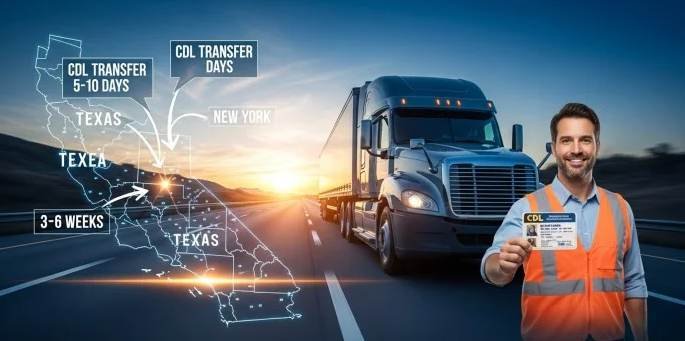
One of the most common issues drivers face is relocating. If you get your CDL in Nebraska and move to Colorado, what happens?
The good news is that the United States uses the CDLIS (Commercial Driver’s License Information System). This federal database ensures that you only have one CDL at a time, and it allows states to talk to each other.
The Standard Transfer Process:
- The Driving Test: If your out-of-state CDL is valid (not suspended), you do not have to retake the driving skills test or the backing maneuvers.
- The Written Test: Most states will waive the General Knowledge, Air Brakes, and Combination written tests.
- The Exceptions: Almost every state will make you take a new Vision Test.
- The HazMat Headache: If you have an ‘H’ (Hazardous Materials) endorsement, you cannot just transfer it. You must pass the HazMat written test in your new state and re-apply for the TSA fingerprint background check all over again.
Warning: You typically have 30 days after establishing residency in a new state to transfer your CDL. Do not wait, or you risk driving on an invalid license.
Conclusion: Stop Searching, Start Studying
Navigating state-specific CDL rules can feel like trying to hit a moving target. While the DMV clerks and state fees will change from region to region, the core mechanics of driving an 80,000-pound commercial vehicle remain exactly the same.
Your immediate focus should be on the Federal Baseline. Whether you are dealing with PennDOT, FLHSMV, or the Texas DPS, you are going to be tested on the same Air Brake leakage rates and the same following distance formulas.
Don’t let the bureaucracy overwhelm you. Prepare your paperwork (especially if you are in a state like New Jersey or California), schedule your DOT physical, and master the core knowledge.
Ready to test your knowledge against the federal standards used by every single state? Start with our comprehensive, updated 2026 practice exams.