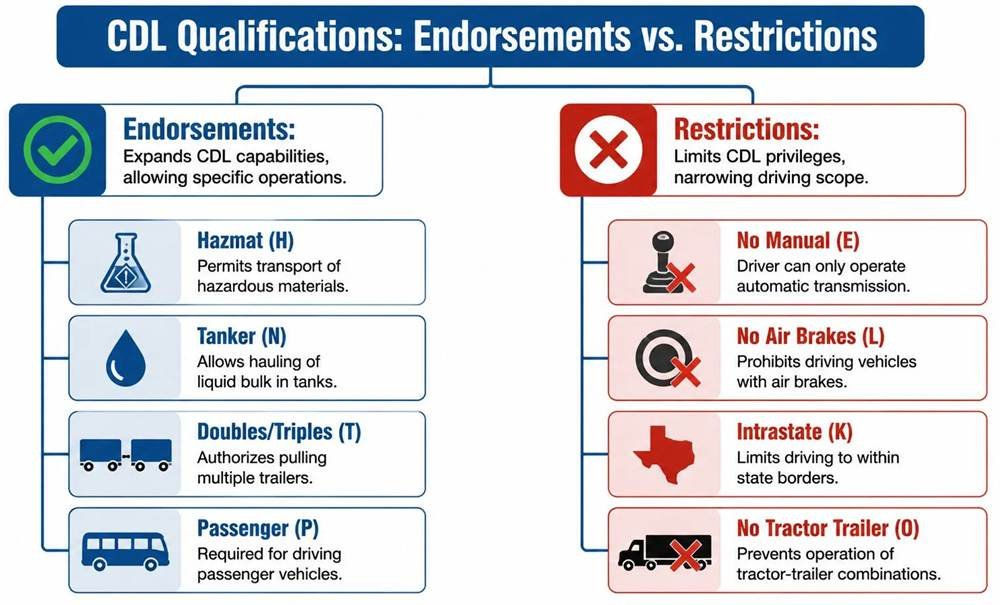
Most drivers do not search CDL restriction codes because they are curious. They search because they found a letter on their license and need an answer fast. If you are trying to figure out what L, E, O, M, or another restriction means, this page is built to help you check the code, understand what it limits, and learn how to remove it.
The most commonly searched CDL restriction codes are the ones that affect jobs the most: L restriction on a CDL license, E restriction on a CDL license, O restriction on CDL Class A, and M restriction on CDL license. Those are the codes we will cover first.
Quick CDL Restriction Codes Chart
| Code | What It Means | What You Cannot Drive | Common Fix |
|---|---|---|---|
| L | No full air brakes | Vehicles with full air brakes | Pass Air Brakes testing in an air brake vehicle |
| E | Automatic transmission only | Manual transmission CDL vehicles | Retake skills test in a manual truck |
| O | No tractor-trailer | Full Class A tractor-trailer combinations | Retake test in a proper combination vehicle |
| M | Class B / Class C only | Class A vehicles | Complete Class A skills test in a Class A vehicle |
| K | Intrastate only | Interstate commercial driving | Meet federal interstate qualifications |
| Z | No full air brakes, air-over-hydraulic only | Full air brake vehicles | Test in a full air brake vehicle |
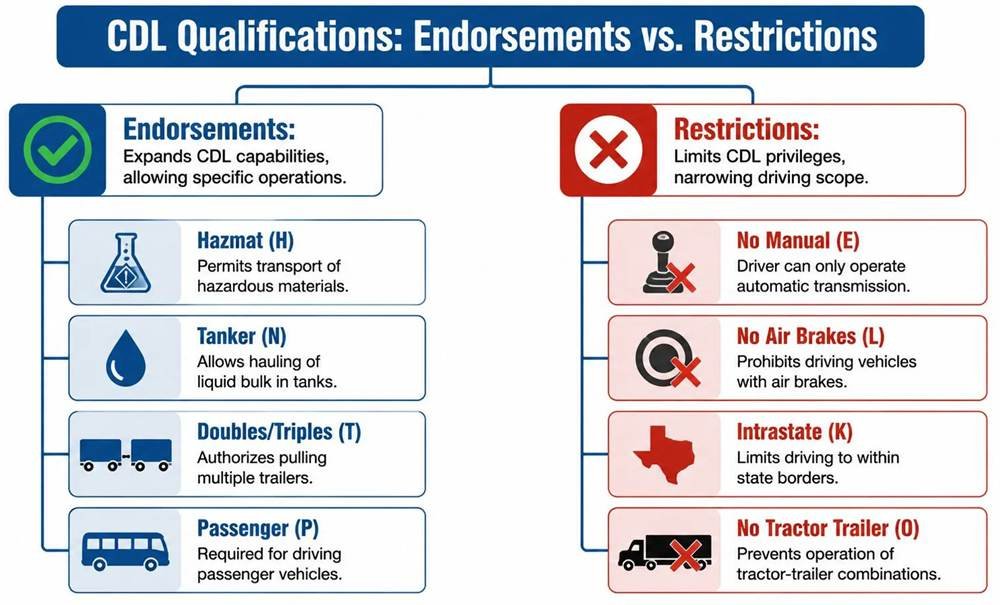
Most Common CDL Restriction Codes: L, E, O, and M
These are the letters users search most often because they affect employability right away.
L Restriction: No Air Brakes
If you are asking what is airbrake restriction or what is the L restriction on a CDL, this is the answer: the L restriction means you cannot operate a commercial motor vehicle equipped with full air brakes.
How it gets added:
- You did not pass the Air Brakes knowledge test.
- You did not test in a vehicle with air brakes.
- You did not demonstrate the required air brake pre-trip knowledge.
Why it matters:
- Most Class A trucks use air brakes.
- Many large Class B vehicles use air brakes too.
- This is one of the most limiting restriction codes for employment.
E Restriction: Automatic Transmission Only
The E restriction on a CDL license means you are limited to commercial vehicles with automatic transmissions only.
How it gets added:
- You took the CDL skills test in an automatic transmission vehicle.
Why it matters:
- Many fleets are automatic now, so the E restriction is less damaging than it used to be.
- But it still blocks some older fleets, vocational trucks, and owner-operator opportunities.
O Restriction: No Tractor-Trailer
The O restriction on a CDL Class A means you cannot operate a full tractor-trailer combination.
How it gets added:
- You did not test in a full tractor-trailer combination.
- You tested in a vehicle configuration that does not qualify as a full Class A combination.
Why it matters:
- It blocks the very type of vehicle most people associate with a Class A CDL.
- It can seriously narrow available Class A jobs.
M Restriction: Class B to Class A Limitation
The M restriction on a CDL license is one of the most confusing codes. It generally means the driver is limited to Class B and Class C vehicles and cannot operate Class A vehicles.
How it gets added:
- The driver passed Class A knowledge tests but took the skills test in a Class B vehicle.
Why it matters:
- It creates a mismatch between what the driver studied for and what the license actually allows.
- It often appears when someone starts with a Class B path and never completes the Class A road test in the right equipment.
How to Remove CDL Restriction Codes
Many users searching this page are not just trying to decode a letter. They want to know how to get rid of it. That is why queries like getting manual restriction removed from a CDL and how do you get rid of the automatic restriction on your CDL show up so often.
| Restriction | Usual Removal Steps |
|---|---|
| L | Pass the Air Brakes knowledge test and demonstrate air brake proficiency in a vehicle with full air brakes |
| E | Retake the CDL skills test in a manual transmission vehicle |
| O | Retake the skills test in a full tractor-trailer combination |
| M | Complete the Class A skills test in a proper Class A vehicle |
| K | Meet interstate qualification requirements, often including age and medical requirements |
| Z | Test in a vehicle with full air brakes instead of air-over-hydraulic |
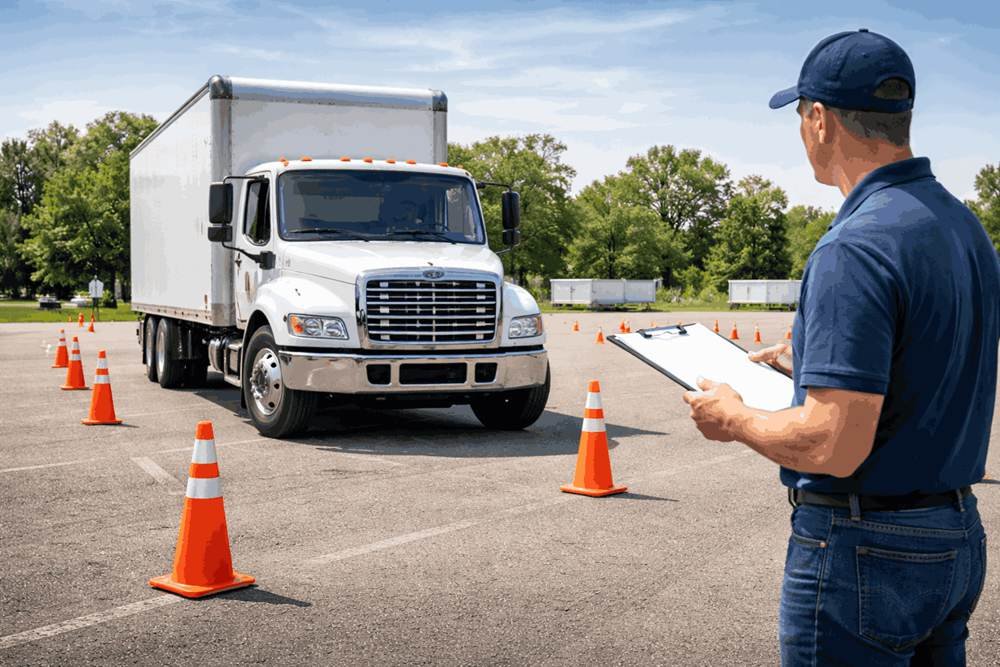
The key pattern is simple: most restriction codes are removed by retesting in the right vehicle and demonstrating the skill you skipped the first time.
Are CDL Restriction Codes the Same in Every State?
This is where many drivers get confused. The broad restriction concepts are similar nationwide, but the exact code formatting is not always identical.
That is why people search things like:
what is restriction m42 on cdl class b license in california meanwhat is the x restriction cdl gamissouri cdl restriction codesare cdl restriction codes different in each state
The safest explanation is:
- Federal-style CDL restriction concepts are generally shared across states.
- States may still use their own numbering, combined codes, or subcodes.
- Some states print additional state-specific descriptors on the license or in DMV records.
If you see a code that looks unusual, do not assume a national guide fully explains it. Check your state CDL manual or DMV website for the state-specific meaning.
Other Less Common CDL Restriction Codes
The four most important restriction codes for most drivers are still L, E, O, and M, but other codes do appear.
K Restriction: Intrastate Only
You are limited to commercial driving within your home state. This commonly affects drivers under 21 or drivers who do not meet federal interstate requirements.
Z Restriction: No Full Air Brakes
This usually means you tested in a vehicle with air-over-hydraulic brakes instead of a full air brake system. It is similar to the air brake restriction issue, but not identical to the L restriction.
V Restriction: Medical Variance
This indicates the driver is operating under a medical variance or waiver, such as a vision or diabetes-related federal allowance.
P Restriction on a CLP
This is usually a permit-stage passenger restriction, not the same thing as a full-license restriction code that permanently limits the type of vehicle you may drive.
What Restriction Codes Hurt Job Options the Most?
If you are job hunting, not all CDL restriction codes hurt equally.
Here is the rough order of impact for most drivers:
- L restriction: one of the worst for Class A candidates because it blocks most air brake vehicles
- O restriction: a major problem for Class A work because it blocks tractor-trailer operation
- E restriction: less serious than before, but still limits manual-truck opportunities
- M restriction: blocks Class A jobs until the driver completes the Class A upgrade properly
- K / V / Z: more situational, depending on route type, medical status, and equipment
If your goal is the broadest possible job market, removing L, O, and E first usually gives the biggest payoff.
Practice the rule questions
Still mixing up L, E, O, M, air brakes, and Class A upgrades? Practice CDL license, restriction, and endorsement questions in the CDL PassMaster app so the rules behind common restriction codes actually stick.
Practice CDL License Rules →Complete CDL Restriction Code Reference Table
| Code | Restriction | Main Impact | Typical Removal Path |
|---|---|---|---|
| L | No full air brakes | Cannot drive most Class A trucks | Pass Air Brakes testing in a full air brake vehicle |
| E | Automatic only | Cannot drive manual trucks | Retake skills test in a manual vehicle |
| O | No tractor-trailer | Cannot drive Class A combinations | Retake test in a full tractor-trailer |
| M | Class B / C only | Cannot drive Class A vehicles | Pass Class A skills test in Class A vehicle |
| K | Intrastate only | Cannot cross state lines commercially | Meet interstate eligibility requirements |
| V | Medical variance | Commercial driving allowed only under variance conditions | Depends on medical clearance status |
| Z | No full air brakes | Limited to air-over-hydraulic or similar systems | Test in a full air brake vehicle |
Conclusion
The best way to think about CDL restriction codes is this: they are not penalties, but they do limit what you can drive and which jobs you can take. If you see L, E, O, or M on your license, it is worth understanding the code early and making a plan to remove it if it is blocking the kind of work you want.
For exam prep, start with our Free CDL Practice Test. For license class differences, read CDL License Classes Explained. For air brake study material, use CDL Air Brake Test Questions and Answers.
Frequently Asked Questions (FAQ)
What does the L restriction mean on a CDL?
The L restriction means you cannot operate a commercial vehicle equipped with full air brakes. It is usually added when you do not pass the air brakes knowledge test or do not test in a vehicle with air brakes.
What does the E restriction mean on a CDL?
The E restriction limits you to commercial vehicles with automatic transmissions only. It is usually added when you take the CDL skills test in an automatic vehicle.
What does the O restriction mean on a CDL?
The O restriction means you cannot operate a full tractor-trailer combination. It is commonly added when you do not test in a proper Class A combination vehicle.
What is the M restriction on a CDL?
The M restriction usually means the driver is limited to Class B and Class C vehicles and cannot operate Class A vehicles until completing the proper Class A skills test.
How do I remove the E restriction from my CDL?
To remove the E restriction, you usually must retake the CDL skills test in a manual transmission vehicle and demonstrate proper shifting and control.
Are CDL restriction codes the same in every state?
Not always. The broad concepts are similar, but some states use additional subcodes, combined codes, or state-specific formats. Always verify unusual codes with your state DMV or CDL manual.