If you are considering a career in trucking, you probably have bills to pay, rent due, and a family to feed. You can’t just put your life on hold indefinitely.
The most urgent question on your mind is: How long does it take to get a CDL?
If you look at billboard advertisements, you will see schools promising to put you in a truck in “as little as three weeks!” While that is technically possible under perfect conditions, it is rarely the reality for the average student in 2026.
Getting a Commercial Driver’s License is a multi-step federal process. It involves medical clearances, government background checks, mandatory training hours, and bureaucratic DMV scheduling.
To give you an honest answer, we need to break down the timeline into the three main paths: the full-time sprint, the weekend warrior route, and the company-sponsored bootcamp. We also need to expose the “hidden delays” that schools conveniently forget to mention.
The Hidden Timeline: Before School Even Starts (1 - 3 Weeks)
The clock doesn’t start on your first day of truck driving school. It starts the day you decide to get your license. Before you can even touch a steering wheel, you have to clear the federal prerequisites.
- The DOT Physical (1-3 Days): You must pass a medical exam to prove you are physically fit to drive 80,000 pounds. Find a certified Medical Examiner on the National Registry. Cost: $80 to $150. Getting the appointment and securing your Medical Examiner’s Certificate is step one.
- Studying for the Permit (1-2 Weeks): You cannot drive a truck without a Commercial Learner’s Permit (CLP). You need to pass three written DMV tests (General Knowledge, Air Brakes, and Combination Vehicles). Unless you are a genius, you need at least a week to study the manual and take practice tests. Start with our Free CDL Practice Test.
- The 14-Day Federal Rule: Once you pass your written tests and get your CLP, federal law dictates a mandatory 14-day waiting period before you can take your final driving test. This is non-negotiable and applies in every state.
So before you even start the “school” portion, you have already invested 2 to 4 weeks. For the full step-by-step licensing guide, see our How to Get a Class A CDL guide.
Path 1: Full-Time Private CDL School (4 - 5 Weeks)
This is the industry standard. If you have the savings to quit your current job and treat CDL school like a 9-to-5 job, this is your fastest reliable route.
Almost all major trucking companies and insurance providers require a certificate proving you completed 160 hours of training.
- The Schedule: Monday through Friday, 8:00 AM to 5:00 PM.
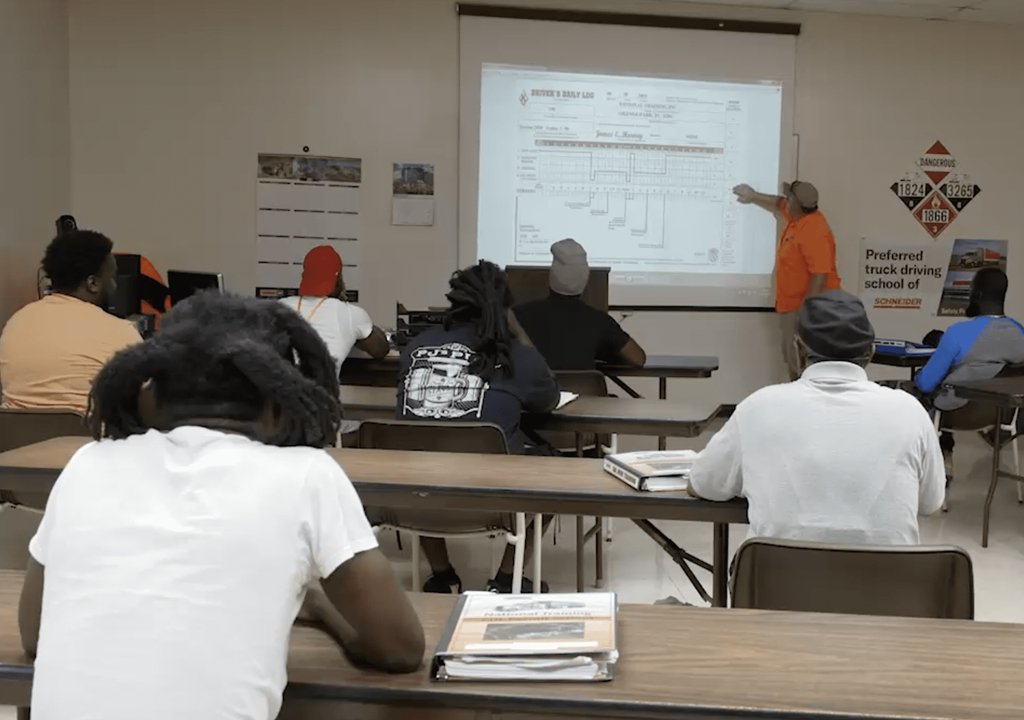
- Week 1 (Theory): Classroom work covering ELDT regulations, logbooks, and safety protocols. In 2026, many students complete this online beforehand through providers listed on the FMCSA Training Provider Registry. See our Online CDL Classes Guide for options.
- Week 2 & 3 (The Range): You will be in the dirt yard learning how to straight-line back, offset back, and alley dock a 53-foot trailer. This takes time to build muscle memory. Expect to spend 4 to 6 hours per day in the truck.
- Week 4 (The Road & Test): Driving on public highways, shifting practice, and your final exam.
Total Timeline for Path 1: About 6 to 8 weeks from “I want a CDL” to holding the plastic card.
Path 2: Weekend CDL Classes (8 - 12 Weeks)
Can you get your CDL while working a full-time job? Yes. Many community colleges and private academies offer weekend CDL classes or night school.
- The Schedule: Typically Saturday and Sunday, 8:00 AM to 5:00 PM.
- The Pros: You don’t lose your current income. You don’t have to drain your savings account to survive the training period.
- The Cons: It is an absolute grind. Working 40 hours a week and then spending your entire weekend at a trucking yard for two and a half months leads to high burnout.
- The “Muscle Memory” Issue: When you learn to back a trailer on Sunday afternoon, and then don’t touch a truck again until the following Saturday, you lose the “feel” of the vehicle. Weekend students often require more total hours to master backing maneuvers because of this gap.
- Tuition: Community college weekend programs typically cost $1,500 to $3,500 - cheaper than full-time private schools.
Total Timeline for Path 2: About 3 to 4 months from start to finish.
Path 3: Company-Sponsored Training (3 Weeks + 2 Months)
If you are completely broke, mega-carriers like Swift, Prime Inc., or Roehl will pay for your training, house you in a hotel, and feed you.
- The Schedule: 6 to 7 days a week, 10 to 12 hours a day. It is an intense bootcamp.
- The Catch: How long does it take to get a CDL this way? You might get the actual plastic license in 3 weeks. But you aren’t done.
- The Contract: To pay back the tuition, you must sign a contract to work for them for 9 to 12 months. If you quit early, you owe the full training cost (often $5,000 to $7,000). See our Paid CDL Training Guide for contract details.
- The Trainer Phase: Even after you get your CDL, the company will not let you drive alone. You must live in a truck with a “Driver Trainer” for 30,000 to 40,000 miles (which takes about 2 to 3 months). You are technically a licensed driver, but you are still in training.
Total Timeline for Path 3: About 4 to 5 months before you are driving solo.
The “X-Factors”: What Slows You Down in 2026
If you are mapping out your transition timeline, do not ignore the bureaucratic bottlenecks. These three factors routinely delay graduations.
1. The DMV Road Test Backlog (Wait time: 2 to 6 weeks)
You finished your 160 hours. You are ready to test. You call the state DMV (or DPS), and they say, “Our next available CDL road test appointment is in six weeks.” This is a massive problem in heavily populated states like Texas, California, and Florida.
- The Solution: When choosing a school, ask if they are a “State-Certified Third-Party Tester.” This means the school has an examiner on staff who is legally allowed to administer the final state exam on their own yard. This bypasses the DMV line entirely.
2. The HazMat Background Check (Wait time: 30 to 60 Days)
If you want to haul fuel or chemicals, you need a Hazardous Materials (H) endorsement. This requires an FBI fingerprint background check through the TSA (Transportation Security Administration). The TSA is notoriously slow.
- The Solution: Apply for your TSA background check the exact same week you get your learner’s permit. Do not wait until you graduate, or you will be sitting at home waiting for clearance before companies will hire you.
3. The Clearinghouse & Drug Screen (Wait time: 1 Week)
Before you can drive a commercial vehicle, your school must run a DOT drug screen and check your background in the FMCSA Drug and Alcohol Clearinghouse. If you take legally prescribed medications (like ADHD medication or certain blood pressure pills), the Medical Review Officer (MRO) has to verify them with your primary care doctor. This back-and-forth faxing can delay your start date. Read our DOT Drug Test Requirements guide to understand the process.
Timeline Summary Table
| Path | Pre-School | Training | Total |
|---|---|---|---|
| Full-Time Private | 2 - 3 weeks | 4 - 5 weeks | 6 - 8 weeks |
| Weekend/Part-Time | 2 - 3 weeks | 8 - 12 weeks | 3 - 4 months |
| Company-Sponsored | 1 - 2 weeks | 3 weeks + 2 months trainer | 4 - 5 months |
| Hybrid DIY | 2 - 3 weeks | 2 - 4 weeks | 4 - 7 weeks |
The Final Verdict
So, how long does it take to get a CDL?
If you are highly motivated, pass your permit tests on the first try, attend a 4-week full-time private school that conducts its own third-party testing, you can go from your couch to a paid trucking job in about 6 weeks total.
If you are taking weekend classes and relying on the state DMV for your testing appointment, realistically plan for the process to take 3 to 4 months.
Take the time to do it right. Rushing through a “CDL mill” in two weeks might get you a piece of plastic, but it won’t give you the skills to safely navigate an 80,000-pound missile down a mountain pass. Pick the timeline that fits your life, and focus on becoming a professional.
Start studying today with our Free CDL Practice Test. While you study, schedule your DOT physical - that gets the clock ticking.
Frequently Asked Questions (FAQ)
How long is full-time CDL school?
A standard, full-time private CDL academy typically takes 4 weeks to complete. This usually consists of 1 week of classroom theory and 3 weeks of behind-the-wheel range and road training, attending 40 hours per week. Some programs extend to 5 or 6 weeks to provide additional practice time. Most programs require about 160 total hours of instruction to meet insurance and carrier hiring requirements.
How long do weekend CDL classes take?
If you are taking part-time weekend CDL classes to keep your day job, the program will generally take 8 to 10 weeks to complete, depending on whether you attend both Saturday and Sunday. The total instruction hours are similar to a full-time program (about 160 hours), but they are spread over a longer calendar period. Community colleges often offer these weekend formats at lower tuition ($1,500 to $3,500).
What is the 14-day CLP waiting period?
Federal law requires that you hold your Commercial Learner’s Permit (CLP) for a minimum of 14 days before you are legally allowed to take the final CDL skills and road test. This waiting period begins the day your CLP is issued by the DMV. You cannot waive or bypass this requirement. Use the 14 days to practice behind-the-wheel skills with a certified instructor and prepare for the pre-trip inspection.
Can I get a CDL faster than 4 weeks?
It is possible but extremely rare. The theoretical minimum is about 3 to 4 weeks if you pass your permit tests immediately, complete online ELDT theory before starting, find a school with immediate availability and third-party testing, and pass the skills test on your first attempt. However, most students encounter at least one delay - DMV scheduling backlogs, permit test retakes, or training schedule conflicts. Plan for 6 to 8 weeks to set realistic expectations.