Paid CDL Training 2026: Company-Sponsored Schools & Contract Traps
Don't just read the guide. Test yourself with the actual questions likely to appear on your CDL test.
Getting your Class A CDL in 2026 is expensive. Thanks to the federal ELDT mandates, you can no longer just borrow a truck and take the test. You must attend an accredited academy, and private trucking schools currently charge anywhere from $5,000 to $8,000 in tuition.
If you are transitioning careers because you are broke, handing over $6,000 cash is simply not an option.
This is why Company-Sponsored CDL Training—frequently advertised as "Paid CDL Training"—is the most popular way to enter the trucking industry. The pitch sounds incredible: We will pay for your bus ticket, put you in a hotel, feed you, train you, and guarantee you a job.
But there is no such thing as a free lunch in trucking.
In this guide, we are going strip away the recruiting brochures and give you the brutally honest truth about how these programs work, how much you actually get paid during training, and the ironclad contracts you must sign to get the keys.
The Reality of the "Free" CDL: The Promissory Note
Before you step onto a Greyhound bus heading to a trucking academy in Missouri or Wisconsin, you need to understand the financial trap you are walking into.
Mega-carriers are not charities. They are investing about $6,000 into getting you licensed. To protect their investment, they will make you sign a Promissory Note.
This contract states that the company will cover your tuition, provided you drive for them for a set period (usually 9 to 12 months, or a specific mileage quota like 120,000 miles).
- The Good: If you complete your one-year contract, your debt is forgiven. You walk away with a free CDL and a year of experience.
- The Ugly: If you quit on month six because you hate your dispatcher, or if you get fired for a minor fender-bender, you owe the full tuition amount immediately. If you don't write them a check, they will send the $6,000 debt to a collections agency and destroy your credit score.
This is why veteran drivers call company-sponsored programs "indentured servitude." You are locked in. But for many, it is the only viable way into the industry.
The 3 Stages of Paid CDL Training
If you accept the contract, what does the timeline look like? Almost all mega-carriers follow a strict three-phase pipeline.
Stage 1: The Academy (2 to 4 Weeks)
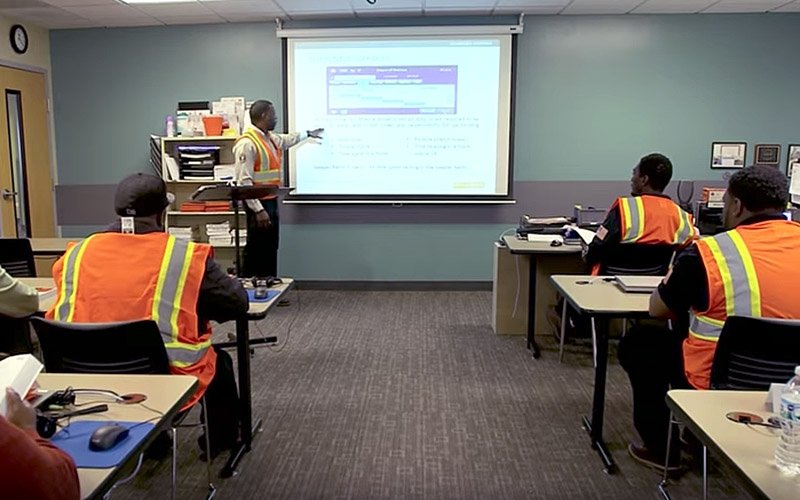
You arrive at the training facility. You take your DOT physical, a rigorous drug test (often including a Hair Follicle test that goes back 90+ days), and start classroom ELDT training. You will then move to the yard to practice backing maneuvers.
- The Pay: In most programs (like Swift or Knight), you are NOT paid during this phase. They provide a hotel and a food card, but no salary.
- The Exception: Companies like Roehl Transport run a true "Paid Apprenticeship" where you are hired as an employee on Day 1 and paid a flat weekly salary (around $600) while sitting in class.
Stage 2: The Mentor Phase / OTR Training (3 to 6 Weeks)
You passed the DMV test. You have your CDL. Now, you are placed in a truck with a "Driver Trainer" or "Mentor" to haul real freight across the country. This is the hardest part of the job. You are living in a 5x7 foot box with a complete stranger. You will drive while they sleep, and they will drive while you sleep (Team Driving).
- The Pay: This is where the "Paid CDL Training" officially kicks in for most companies. You are typically paid a flat rate of $700 to $900 per week.
Stage 3: Solo Upgrade (Months 3 through 12)
You pass your final evaluation and are handed the keys to your own truck. You are now an official solo company driver.
- The Pay: You transition from a flat weekly rate to Cents Per Mile (CPM). As a rookie fulfilling a contract, your CPM will be low (usually between $0.45 and $0.50 per mile).
- The Deduction: Depending on the contract, the company may deduct $30 to $50 from your weekly paycheck to pay down your "tuition" over the course of your first year.
Top Company-Sponsored Programs in 2026
If you are going to sign a contract, you need to pick the right partner. Here is how the top players stack up in 2026.
1. Roehl Transport (The GYCDL Program)
Roehl’s "Get Your CDL" program is widely considered the most honest paid CDL training in the industry.
- The Big Perk: You are a W-2 employee on Day 1. They pay you $600+ a week while you are practicing in the yard.
- The Contract: Instead of a time limit, it is based on miles. You must drive 120,000 solo miles (which usually takes about 15 months) to satisfy the contract.
- Culture: Better home-time options than most mega-carriers and a massive focus on safety.
2. Prime Inc.
Prime is a powerhouse in the Refrigerated (Reefer) and Flatbed sectors. Their training program is famously tough but highly lucrative.
- The Big Perk: Exceptional training pay. Once you get your CDL permit, you go out with an instructor and are guaranteed $900 per week during the TNT (over-the-road training) phase.
- The Training Style: Unlike other companies that rush you through a parking lot academy, Prime does 1-on-1 training. You learn to drive on the actual highway with an instructor beside you.
- The Contract: Exactly 1 year.
3. Swift Transportation / Knight
The largest carrier in North America. They have academies located all over the country, making them the most accessible option.
- The Big Perk: They are a "second chance" company. If you have gaps in your employment or a slightly blemished record, Swift is the most likely to accept you.
- The Downside: You are generally not paid during the initial 3-week academy phase (only hotel/travel is covered). Their starting solo CPM is also on the lower end of the industry average.
- The Contract: 1 year.
The Alternative: Private School + Tuition Reimbursement
If the idea of being locked into a 1-year contract terrifies you, you have one other option: Tuition Reimbursement.
If you can manage to secure a $6,000 loan from a bank, or pay cash for a private community college CDL program, you become a "Free Agent." When you graduate, you can apply to almost any carrier (like Schneider or Werner). Because you already have your CDL, they will offer you Tuition Reimbursement. They will add an extra $200 a month to your paycheck to help you pay off your loan. The beauty here? No contract. If you quit after three months, you stop getting the $200 bonus, but you don't owe the trucking company a dime.
Conclusion: Is it Worth It?
Paid CDL training is the ultimate double-edged sword.
It is the fastest way to pull yourself out of poverty and secure a reliable, recession-proof career without going into massive student debt. But you must be mentally prepared for the grind. The first year of trucking is brutal. You will be away from home, making rookie mistakes, and earning rookie pay.
If you can put your head down, survive the Mentor phase, and fulfill your 12-month contract, the doors to the industry blow wide open. On day 366, you can quit, take your CDL, and apply for a premium local or dedicated route making $80,000+ a year.
Ready to start? Before you apply to any of these companies, you need to make sure you can pass the mandatory medical exam. Check out our2026 DOT Physical Requirements Guide to ensure you won't get sent home on Day 1 for high blood pressure.
Combination
Learn the 5-step coupling checklist and rollover prevention techniques.
Explore More Practice Tests
General Knowledge
The #1 starting point. Covers vehicle inspections & basic road safety rules.
HazMat (H)
Master the placarding tables, shipping papers, and TSA requirements.
Air Brakes (L)
Memorize critical PSI numbers and the 3-step L.A.B. check process.
Combination
Learn the 5-step coupling checklist and rollover prevention techniques.
Pass Your CDL Exam First Try
Don't guess. Practice with 1000+ real exam questions updated for 2026.
Start Free Practice