CDL Air Brake Test Questions & Answers 2026: The Cheat Sheet
Don't just read the guide. Test yourself with the actual questions likely to appear on your CDL test.
The Air Brakes Endorsement is the single most technical part of the CDL exam. Unlike General Knowledge which uses common sense, Air Brakes requires memorizing specific numbers and understanding pneumatic physics.
If you fail this section, you will get an "L" Restriction, meaning you can't drive a semi-truck. Below are the hardest questions from the 2026 database, explained using our "Cheat Sheet" method.
1. The "Magic Numbers" Cheat Sheet
Memorize this table. 50% of the cdl air brake test questions and answers come from these numbers alone.
| Component | The Number |
|---|---|
| Compressor Cut-Out | 125 - 140 psi |
| Compressor Cut-In | 100 psi |
| Low Air Warning | Must active by 60 psi |
| Emergency Brakes Pop Out | 20 - 45 psi |
| Leak Rate (Combination) | Less than 4 psi in 1 min (Applied) |
2. Hardest Practice Questions Explained
Q1: Your truck has a dual air system. One of the systems loses pressure. What will happen?
- A. The parking brakes will pop out immediately.
- B. Either the front or rear brakes will not operate fully.
- C. The truck will stop instantly.
Correct Answer: B.
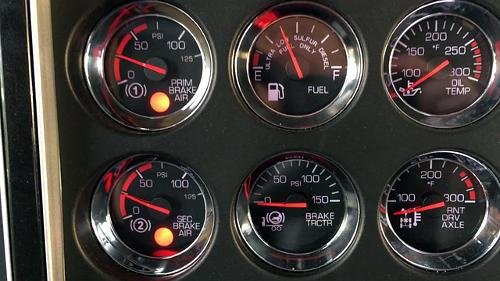
- Why? Modern trucks have two separate air systems (Primary and Secondary). One usually controls the rear axle, and the other controls the front. If one fails, the other system still allows you to brake safely to a stop. You won't lose all braking power immediately, but you must stop.
Q2: How can you check if your slack adjusters are out of adjustment?
- A. By pressing the brake pedal hard.
- B. Park on level ground, chock wheels, release parking brake, and pull the slack adjuster by hand.
- C. Look at them from the cab.
Correct Answer: B.
- Why? This is a physical inspection. You must pull the slack adjuster. If it moves more than 1 inch (for the standard Type 30 chamber), it is illegal and out of adjustment. The push rod will travel too far, and the brakes won't work.
Q3: The application pressure gauge shows how much air pressure you:
- A. Have in the tanks.
- B. Are applying to the brakes.
- C. Have left in the emergency line.
Correct Answer: B.
- Why? Do not confuse the "Supply Pressure Gauge" (tank air) with the "Application Pressure Gauge." The application gauge only moves when you push the pedal.
3. The 3-Step Air Brake Check (L.A.B.)
You must know this order for the Skills Test. It is an automatic fail if you mess this up.
- L (Leaks): Turn engine off, key on. Release parking brakes. Press foot brake hard. Watch gauge. (Max drop 4 psi/min).
- A (Alarm): Fan the brakes. Warning light/buzzer MUST come on before 60 psi.
- B (Button): Continue fanning. The protection valves (Buttons) MUST pop out between 20-45 psi.
Air Brakes (L)
Memorize critical PSI numbers and the 3-step L.A.B. check process.
Conclusion
Air Brakes aren't just about passing a test; they are about stopping 80,000 lbs safely. Master the LAB test and the cheat sheet numbers, and you will pass.
Explore More Practice Tests
General Knowledge
The #1 starting point. Covers vehicle inspections & basic road safety rules.
HazMat (H)
Master the placarding tables, shipping papers, and TSA requirements.
Air Brakes (L)
Memorize critical PSI numbers and the 3-step L.A.B. check process.
Combination
Learn the 5-step coupling checklist and rollover prevention techniques.
Pass Your CDL Exam First Try
Don't guess. Practice with 1000+ real exam questions updated for 2026.
Start Free Practice