CDL HazMat Study Guide 2026: Placards, Rules & TSA Background Check
Tip: Press Ctrl+P (or Command+P on Mac) to save this page as a PDF. The hazard class table and placard rules below are formatted for clean printing. Treat this as your cdl hazmat study guide pdf — keep it on your phone or print it out for the truck cab.
The HazMat endorsement (Code H) is the hardest endorsement to earn on a CDL, and the most valuable to hold. Drivers with HazMat clearance earn $5,000 to $15,000 more per year than drivers without it. Tanker + HazMat + Doubles/Triples is the combination that unlocks the highest-paying jobs in the industry.
But the process is brutal. You do not just take a written test. You have to submit fingerprints, pass a federal terrorism background check conducted by the TSA, and wait 30 to 45 days for approval. Most people fail the written test because they underestimate how specific the questions are about placard rules, shipping papers, and segregation tables.
This cdl hazmat study guide covers everything you need: the TSA process, the 9 hazard classes, the 1,001 lbs placard rule, and the specific material the DMV exam tests you on. Consider this your complete cdl hazmat study book — read it start to finish, then use the tables as a cheat sheet for review.
The TSA Threat Assessment: The Part Nobody Warns You About
Before we get into the study material, you need to understand the TSA process because it is the number one reason people abandon the HazMat endorsement halfway through.
Step 1: Pass the Written Test at the DMV
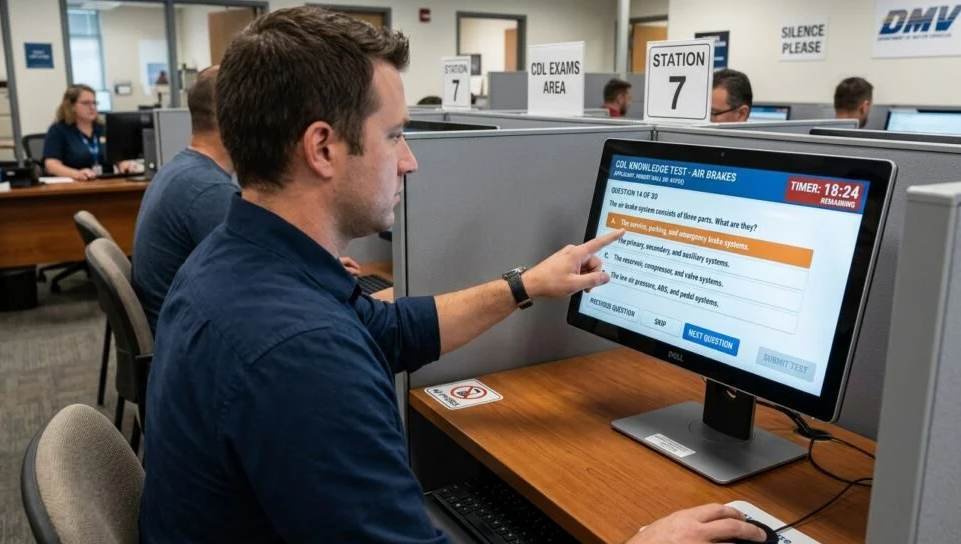
Take the HazMat knowledge test at your local DMV. It is usually 30 questions. You need 80% to pass. This is the easy part.
Step 2: Schedule Fingerprinting
After passing the written test, you must schedule an appointment with an approved TSA enrollment provider (Idemia is the current contractor). You can find locations at the TSA website. Bring:
- Your CDL or permit
- A valid passport OR birth certificate + government-issued photo ID
- The $86.50 fee (credit card preferred, some locations accept cash)
They will scan all ten fingerprints and take a new photo.
Step 3: Wait 30-45 Days
The TSA runs your fingerprints through:
- FBI criminal history database
- Immigration and citizenship records
- Terrorist watch lists and no-fly lists
- Warrant databases
You cannot expedite this. You cannot call and ask for an update. You wait.
Step 4: Receive Determination Letter
If you pass, the TSA sends an approval letter to your state DMV, and the H endorsement is added to your license. If you fail, you receive a letter explaining why, and you have the right to appeal.
What Disqualifies You
The TSA will deny your HazMat application if you have:
- Certain felony convictions within the past 7 years (or lifetime for some offenses)
- Outstanding warrants
- Convictions for explosives, treason, or terrorism-related offenses (lifetime ban)
- Dishonorable military discharge
- Being found mentally incompetent by a court
If you have a criminal record, check the full disqualifying offenses list on the TSA website before spending the $86.50.
The 9 Hazard Classes (Cheat Sheet)
This is the foundation of the entire cdl hazmat study guide. Every question on the DMV test references these nine classes. Memorize the number, the name, and the placard color for each one.
| Class | Name | Placard Color | Common Examples |
|---|---|---|---|
| 1 | Explosives | Orange | Dynamite, TNT, fireworks, ammunition |
| 2 | Gases | Varies by division | Propane, oxygen, chlorine, acetylene |
| 3 | Flammable Liquids | Red | Gasoline, diesel fuel, acetone, paint |
| 4 | Flammable Solids | Red/white stripes | Matches, sulfur, magnesium |
| 5 | Oxidizers / Organic Peroxides | Yellow | Ammonium nitrate, hydrogen peroxide |
| 6 | Toxic / Infectious Substances | White | Pesticides, medical waste, cyanide |
| 7 | Radioactive | White/Yellow | Uranium, medical isotopes, cobalt-60 |
| 8 | Corrosives | Black/white split | Battery acid, drain cleaner, sulfuric acid |
| 9 | Miscellaneous Dangerous Goods | White/vertical stripes | Dry ice, lithium batteries, asbestos |
On the test: You will be shown placard images and asked to identify the hazard class. You will also be given a scenario ("You are hauling gasoline in a tanker") and asked which class it falls under. The answer is Class 3, flammable liquids, red placard.
Print this table. Pin it to your wall. This is the core of your cdl hazmat study book material.
The 1,001 lbs Rule: When Placards Are Required
This is the single most tested concept on the HazMat exam. Get this wrong and you will fail.
Table 1 Materials (Always Placard)
Some hazardous materials are so dangerous that you must display placards for any amount being transported. These are called Table 1 materials and include:
- Class 1 (Explosives): Divisions 1.1, 1.2, 1.3
- Class 2.3 (Poison Gas): Poisonous gases
- Class 4.3 (Dangerous When Wet): Materials that react with water
- Class 5.2 (Organic Peroxides): Type B
- Class 6.1 (Poison): Materials meeting specific toxicity thresholds
- Class 7 (Radioactive): Highway route controlled quantities
If you have even one pound of any Table 1 material on your truck, all four sides must be placarded. No exceptions. No weight threshold.
Table 2 Materials (The 1,001 lbs Threshold)
For everything else (Table 2 materials), the rule is straightforward:
You must placard when the aggregate gross weight of all Table 2 hazardous materials on your truck exceeds 1,001 lbs.
That means you add up the weight of the HazMat cargo (not the packaging, not the trailer — just the hazardous material itself). If the total is 1,001 lbs or more, placard all four sides.
If you are hauling 800 lbs of Class 3 flammable liquid and 300 lbs of Class 8 corrosive material, your aggregate gross weight is 1,100 lbs. You are over the threshold. You need placards for both the Class 3 and Class 8 materials.
Placard Placement Rules
When placards are required, here is how they must be displayed:
- All four sides of the vehicle — front, rear, left, right
- Readable from 50 feet in daylight
- Not obscured by mud, tarps, or damage
- Square-on-point diamond shape — rotated 45 degrees
- Color-coded to match the hazard class
- ID number displayed on the placard or on an orange panel next to it
The "No Placard" Trap
Here is a trick question the DMV loves: You are hauling 800 lbs of Class 3 flammable liquid. Do you need placards?
Answer: No. 800 lbs is below the 1,001 lbs threshold. Class 3 is a Table 2 material, and you are under the weight limit. No placards required — but you still need shipping papers and proper packaging.
Shipping Papers: The Bureaucracy Test
The cdl hazmat study guide material on shipping papers is less exciting than placard rules but just as heavily tested. The DMV wants to know that you understand the documentation requirements.
What Must Be on the Shipping Papers
- Proper shipping name of the hazardous material (exactly as listed in the Hazardous Materials Table in 49 CFR 172.101)
- Hazard class number
- UN/NA identification number (e.g., UN1203 for gasoline)
- Packing group (I, II, or III — indicates danger level)
- Quantity and type of packaging
- Emergency contact phone number
Where to Keep Shipping Papers
- Within arm's reach of the driver's seat when the vehicle is attended
- On the driver's seat when the vehicle is unattended
- Clearly visible — not buried under other paperwork
- In a pouch on the driver's door is also acceptable
The test will ask: "Where should you keep HazMat shipping papers while driving?" The answer is within arm's reach of the driver's seat, or on the driver's seat when unattended.
The Emergency Response Guidebook (ERG)
Every HazMat driver must carry an Emergency Response Guidebook in the cab. The ERG is a reference manual that tells first responders how to handle a spill, fire, or leak for every classified hazardous material.
- You identify the material by its UN number on the shipping papers
- You look up the UN number in the ERG yellow pages
- You follow the guide number for isolation distances and evacuation procedures
The DMV test asks about the ERG's purpose and where to find information in it. You do not need to memorize specific guide numbers, but you need to know the lookup process.
Loading and Unloading Rules
The DMV tests specific rules about how HazMat must be loaded, segregated, and secured.
Segregation (Separation of Incompatible Materials)
Certain hazard classes cannot be loaded next to each other because they react violently when mixed. The Segregation Table in 49 CFR 177.848 defines which classes must be separated.
Key rules to remember:
- Explosives (Class 1) must be separated from most other classes
- Flammable liquids (Class 3) cannot be loaded near oxidizers (Class 5)
- Poisonous materials (Class 6.1) must be separated from food products
- Radioactive materials (Class 7) have strict distance requirements from other cargo
The "No Smoking" Rule
This is non-negotiable. No smoking within 25 feet of any HazMat loading or unloading operation. The test will ask about the distance. It is 25 feet.
Attendance Requirements
When loading or unloading Class 1 (Explosives), Class 2 (Gases), or Class 7 (Radioactive) materials, the vehicle must be attended at all times. You cannot walk away to get lunch while the truck is being loaded with propane.
HazMat Practice Questions
Class 3 (Flammable Liquids) is a Table 2 material. The 1,001 lbs rule applies. At 1,200 lbs, you are over the threshold. Placards are required on all four sides of the vehicle, regardless of whether you cross state lines.
Division 1.1 explosives are a Table 1 material. Table 1 materials require placards at any quantity — even 5 lbs. The 1,001 lbs threshold only applies to Table 2 materials.
Shipping papers must be within arm's reach of the driver's seat when the vehicle is attended. When you leave the vehicle unattended, the papers go on the driver's seat. They never go in the glove compartment or the trailer.
The ERG is a reference for emergency response. You look up the material by its UN number (found on shipping papers), then follow the guide number for isolation distances, evacuation procedures, and firefighting guidance. Every HazMat driver must carry one in the cab.
HazMat (H)
Master the placarding tables, shipping papers, and TSA requirements.
Conclusion
The HazMat endorsement is not something you can cram for the night before. The placard rules are specific, the TSA background check takes weeks, and the test questions are designed around numerical traps and scenario-based reasoning. Use this cdl hazmat study guide as your primary reference. Print the 9 hazard class table and pin it where you can see it daily. Master the 1,001 lbs rule until it is automatic. And start your TSA fingerprint appointment early — the 30-45 day wait is the real bottleneck.
For more practice, try our Free CDL Practice Test with HazMat questions and explanations. For the other endorsements you need to maximize your earning potential, check our CDL Endorsement Guide and CDL X Endorsement Guide.
Frequently Asked Questions (FAQ)
How do I get the HazMat endorsement on my CDL?
The process has three steps. First, pass the HazMat written knowledge test at your DMV (30 questions, 80% passing score). Second, schedule a fingerprinting appointment with a TSA-approved enrollment center. Third, wait 30-45 days for the TSA Security Threat Assessment to clear. Once approved, the H endorsement is added to your CDL.
What is the TSA background check for HazMat?
The TSA Security Threat Assessment is a federal background check that includes 10-fingerprint scanning, criminal history review through the FBI database, immigration status verification, and terrorism watch list screening. It costs $86.50 and is required for every HazMat endorsement and renewal.
What are the 9 hazard classes for CDL?
The 9 hazard classes are: 1-Explosives, 2-Gases, 3-Flammable Liquids, 4-Flammable Solids, 5-Oxidizers and Organic Peroxides, 6-Toxic and Infectious Substances, 7-Radioactive, 8-Corrosives, 9-Miscellaneous Dangerous Goods. Each class has a specific placard color and shape that you must recognize on the DMV exam.
When do you need a placard on a truck?
Two rules apply. For Table 1 materials (explosives, poison gas, dangerous-when-wet materials), placards are required at any amount. For Table 2 materials, placards are required when the aggregate gross weight of all hazardous materials on the vehicle exceeds 1,001 lbs. Placards must be displayed on all four sides.
Can I print this CDL HazMat study guide as a PDF?
Yes. Press Ctrl+P (or Command+P on Mac) in your browser to save this entire page as a PDF. The hazard class table and placard rules are formatted for clean printing. Keep the cdl hazmat study guide pdf on your phone or print a hard copy for offline study.
How much does the HazMat endorsement cost?
The TSA background check costs $86.50. Your state DMV charges an additional endorsement fee (typically $5-$20). Some states charge separately for the knowledge test. Total out-of-pocket cost is usually $100 to $130, not including study materials or the DOT physical if you need a new one.
Explore More Practice Tests
General Knowledge
The #1 starting point. Covers vehicle inspections & basic road safety rules.
HazMat (H)
Master the placarding tables, shipping papers, and TSA requirements.
Air Brakes (L)
Memorize critical PSI numbers and the 3-step L.A.B. check process.
Combination
Learn the 5-step coupling checklist and rollover prevention techniques.
Pass Your CDL Exam First Try
Don't guess. Practice with 1000+ real exam questions updated for 2026.
Start Free Practice