The CDL In-Cab Air Brake Check Script 2026: Word-for-Word Pass Guide
Don't just read the guide. Test yourself with the actual questions likely to appear on your CDL test.
You can double-clutch a 10-speed transmission flawlessly. You can straight-line back a 53-foot trailer with your eyes closed. But if you sit in the driver's seat and mess up the air brakes test for cdl, the examiner will ask you to step out of the truck.
You just failed. Go home and rebook your test for next month.
The In-Cab Air Brake Inspection is the most stressful five minutes of the entire CDL testing process. It is not a driving test; it is a high-stakes memory performance. The DMV examiner has a clipboard with a specific checklist. If you perform the steps out of order, or if you forget to say the exact right words, you accumulate points. If you make a critical safety error (like forgetting to chock your wheels), you fail instantly.
To survive this, you do not need a textbook. You need a script.
We have designed the ultimate cdl air brake test cheat sheet. This is the exact, word-for-word cdl in-cab air brake test script you must recite out loud to the examiner in 2026. Print this page. Memorize it like an actor memorizing lines for a movie.
Step 0: The "Automatic Fail" Pre-Check
Before you even look at the dashboard, you must secure the vehicle. If you skip this step, when you release the brakes later in the test, the truck will roll. The examiner will hit the emergency brake and fail you.
- Action: Grab your wheel chocks, step out of the truck, and place them securely in front of and behind one of the drive tires.
- Action: Climb back in. Fasten your seatbelt.
- The Script: "My seatbelt is securely mounted, not cut or frayed, and latches properly. My wheels are chocked outside."
Step 1: Safe Start & Build Air
You need full air tanks to start the test.
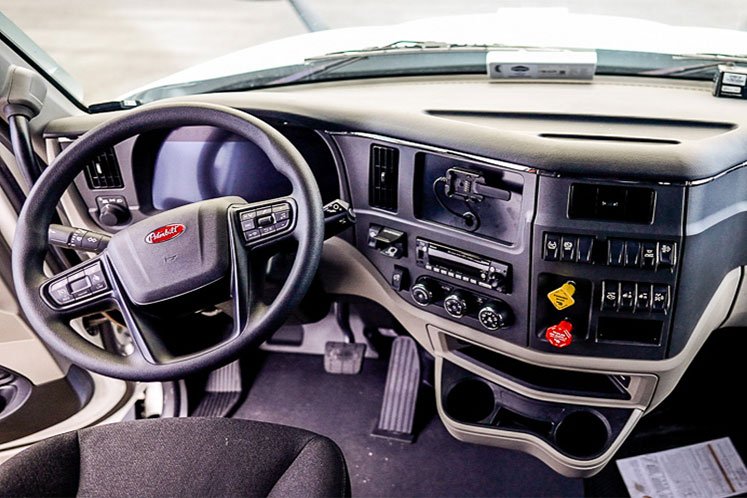
- Action: Make sure the transmission is in Neutral. Ensure both the Yellow (Tractor) and Red (Trailer) brake valves are PULLED OUT (set). Start the engine.
- The Script: "I am performing a safe start. The ABS light came on and went off. I am now going to build my air pressure to the governor cut-out, which is between 120 and 140 PSI."
- Action: Gently press the accelerator to about 1,000 RPMs to build air faster. Wait until you hear the loud Pshhh (the governor sneezing).
- The Script: "The governor has cut out. My primary and secondary air tanks are full."
The L.A.B. Sequence (The Core Test)
This is the meat of the air brakes test for cdl. L.A.B. stands for Leaks, Alarm, Buttons. You must do these in exact order.
THE FATAL TRAP: You must turn the engine OFF, but turn the electrical key back ON. If you leave the key off, your gauges and alarms will not work, and you will fail.
- Action: Turn the engine OFF. Turn the key back to the ON position. Push BOTH the Yellow and Red knobs IN (Release brakes). Wait for the air needles to settle.
L is for Leaks (The Applied Leakage Test)
- Action: Press the foot brake pedal firmly and hold it down. DO NOT move your foot.
- The Script: "I am applying firm pressure to the service brake. After the gauges settle, I should not lose more than 4 PSI in one minute for a combination vehicle." (Say 3 PSI if testing in a Class B straight truck).
- Action: Look at your watch or phone. Time a full 60 seconds. Do not guess. Actually wait.
- The Script: "One minute has passed. I did not lose more than 4 PSI. My system has no major leaks."
A is for Alarm (Low Air Warning)
- Action: Start pumping (fanning) the foot brake rapidly to release air from the tanks. Point to your air gauges.
- The Script: "I am fanning the brakes to test the low air warning alarm. The warning light and buzzer should activate at or above 60 PSI."
- Action: Keep pumping until the loud buzzer sounds and the red light illuminates on the dash.
- The Script: "The low air warning light and buzzer have activated at [Read the exact number on the gauge, e.g., 65 PSI]."
B is for Buttons (Spring Brakes Pop-Out)
- Action: Continue pumping the foot brake rapidly. Keep your eyes on the Yellow and Red knobs.
- The Script: "I will continue fanning the brakes. Both the tractor protection valve and the parking brake valve should pop out between 20 and 45 PSI."
- Action: Pump until POP! POP! Both knobs violently snap out.
- The Script: "Both valves have popped out at [Read the gauge, e.g., 30 PSI]. My emergency spring brakes are functioning properly."
Step 3: The Tug Tests (Proving the Brakes Hold)
You have proven the air system works. Now you must prove the mechanical brake pads actually hold the truck.
- Action: Step outside, remove the wheel chocks, and climb back in. Perform a Safe Start (Engine ON) and build your air pressure back up to 120 PSI.
1. Tractor Parking Brake Test
- Action: Push the RED knob IN (releasing trailer). Leave the YELLOW knob OUT (holding the tractor). Put the truck in 1st gear (or Drive).
- The Script: "I am testing the tractor parking brake."
- Action: Gently ease off the clutch/press the gas. The truck should tug but not move.
- The Script: "The tractor brake holds."
2. Trailer Emergency Brake Test
- Action: Pull the RED knob OUT (holding the trailer). Push the YELLOW knob IN (releasing the tractor).
- The Script: "I am testing the trailer emergency brake."
- Action: Gently ease off the clutch. The truck should tug against the trailer but not move.
- The Script: "The trailer brake holds."
3. Service Brake Test (The Roll Test)
- Action: Push BOTH the Yellow and Red knobs IN (all brakes released).
- The Script: "I am testing the service brake. I will pull forward at 5 MPH and apply the foot pedal."
- Action: Roll forward slowly. Take your hands slightly off the steering wheel (just hovering over it) and press the brake pedal firmly.
- The Script: "The truck stopped smoothly. It did not pull to the left or the right, which indicates my brakes are properly adjusted and I have no steering issues. This concludes my air brake inspection."
Pro Tips for the Examiner's Clipboard
Having a printed cdl air brake test cheat sheet is great for practice, but how you act matters just as much as what you say.
- Point and Touch: When you say "Primary Air Gauge," physically tap the glass of the gauge. Examiners love this. It proves you aren't just reciting a memorized poem; you actually know where the parts are.
- Speak Loudly: Truck cabs are noisy, especially if a reefer unit is running next to you. Project your voice.
- Don't Rush: The biggest enemy of the cdl in-cab air brake test script is adrenaline. If you stumble on a word, stop, take a breath, and correct yourself. The examiner is not timing you to finish quickly; they are watching to see if you are safe.
You have the script. Now put in the reps. Sit in your personal car if you have to, close your eyes, and pantomime the motions until it becomes muscle memory. Once you've mastered the in-cab test, make sure you are ready for the written portion by taking our Free Air Brakes Practice Exam.
Air Brakes (L)
Memorize critical PSI numbers and the 3-step L.A.B. check process.
Explore More Practice Tests
General Knowledge
The #1 starting point. Covers vehicle inspections & basic road safety rules.
HazMat (H)
Master the placarding tables, shipping papers, and TSA requirements.
Air Brakes (L)
Memorize critical PSI numbers and the 3-step L.A.B. check process.
Combination
Learn the 5-step coupling checklist and rollover prevention techniques.
Pass Your CDL Exam First Try
Don't guess. Practice with 1000+ real exam questions updated for 2026.
Start Free Practice