CDL Manual in Spanish 2026: PDF Downloads & Bilingual Study Guide
Don't just read the guide. Test yourself with the actual questions likely to appear on your CDL test.
The Latino community forms the absolute backbone of the American supply chain in 2026. You have the work ethic, the mechanical aptitude, and the drive to handle an 80,000-pound rig.
However, for many aspiring drivers, the only thing standing between them and a six-figure trucking career is a 180-page book written in highly technical, bureaucratic English. Understanding complex pneumatic engineering terms like "Air Brake Lag Distance" is difficult enough, let alone when it is not in your native language.
The good news is that you do not have to study entirely in English. Finding an official cdl manual in spanish (Manual de Licencia de Conducir Comercial) is the secret strategy that thousands of bilingual drivers use to pass their written DMV exams on the very first try.
This comprehensive 2026 guide will break down the strict FMCSA language laws, show you exactly which states provide the translated PDFs, and teach you our proven "Spanglish Method" to survive the English-only road test.
The Federal Law: FMCSA Rule 391.11 Explained
Before you start downloading study materials, you must understand the legal reality of being a bilingual commercial driver in the United States.
Can you take the tests in Spanish? It depends entirely on which test you are taking.
Under FMCSA 49 CFR § 391.11(b)(2), a commercial driver is required to:
"Read and speak the English language sufficiently to converse with the general public, to understand highway traffic signs and signals in the English language, to respond to official inquiries, and to make entries on reports and records."
Here is how state DMVs enforce this federal rule today:
- The Written Permit Test (CLP): The states want to ensure you understand safety concepts. Therefore, major states (like Texas, California, and Florida) will allow you to sit at the computer kiosk and take the General Knowledge, Air Brakes, and Combinations exams in Spanish.
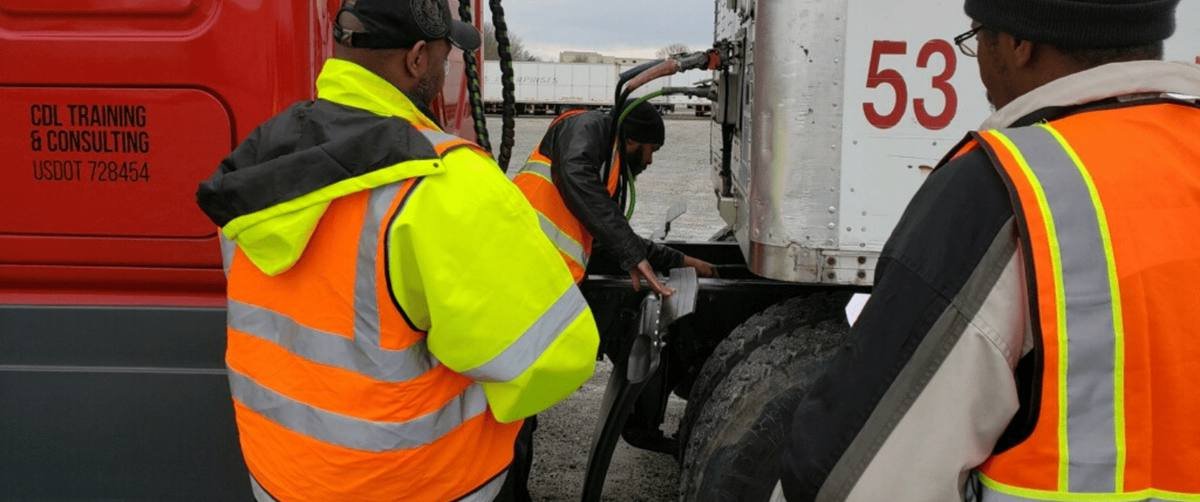
- The Skills / Road Test: This is the absolute hard stop. You cannot bring a translator into the truck. The examiner will give you driving instructions in English, and you must recite the Pre-Trip Inspection entirely in English.
- DOT Weigh Stations: If a DOT officer pulls you over for a random inspection in Ohio, you must be able to answer their basic questions and present your logbook in English.
Where to Find Your Official CDL Manual in Spanish
Because 95% of the trucking regulations (Air Brakes, Cargo Securement, HazMat) are mandated by the federal government, the physics and the laws do not change across state lines. A truck's brakes work the exact same way in Nevada as they do in Florida.
Therefore, if your home state does not print a translated book, you can download a cdl manual in spanish from a major state to study the core concepts.
Here is the 2026 directory for finding the official government PDFs:
1. California (Form DL-650 S)
California offers the most robust resources for Spanish-speaking drivers. The CA DMV officially publishes the DL 650 S (Manual del Automovilista Comercial de California).
- How to get it: Go to the official
dmv.ca.govportal. Under the forms section, search for "DL 650 S". It is a free PDF download. They also frequently update it to reflect the newest Modernized Skills Test rules.
2. Texas (The TX DPS Handbook)
Texas accommodates a massive Spanish-speaking logistics workforce.
- How to get it: Visit the Texas Department of Public Safety (DPS) website at
dps.texas.gov. Navigate to the Driver License section, where they host the Manual de Conductores Comerciales. - Critical Warning for TX Drivers: While you can study the manual in Spanish, the unique "Section 14" (Texas Special Requirements) test is often only administered in English at certain rural DPS kiosks. Be prepared.
3. Florida (The FLHSMV Manual)
To serve the massive populations in Miami and Orlando, Florida updates its Spanish CDL handbook annually.
- How to get it: Go to
flhsmv.gov/resources/handbooks-manuals. You will find a highly accurate Spanish translation of the entire AAMVA testing model.
4. New York & Illinois
Both the Illinois Secretary of State (SOS) and the NY DMV offer translated manuals directly on their websites. New York's translated manual is exceptionally useful if you need to study for the highly specific NY "Metal Coil" endorsement.
The "Spanglish Method": Mastering the Pre-Trip Inspection
If you read a cdl manual in spanish, you will perfectly understand why an air compressor cuts out at 125 PSI. But if you walk into your practical road test and point to the engine saying "Compresor de aire," the examiner will fail you.
You need to bridge the language gap. We call this the Spanglish Method.
- Read for Comprehension: Read the Air Brakes chapter in your Spanish manual first. Grasp the actual mechanical logic and physics.
- Study for the Test: Open the English manual to the exact same chapter. Take a highlighter and mark the specific English names of the truck parts.
- The 3 Magic Words: During your Pre-Trip inspection, you will repeat one phrase for almost every part on the truck. In Spanish, it means No agrietado, doblado o roto. You must permanently burn the English translation into your brain: "Not Cracked, Bent, or Broken."
The Bilingual Pre-Trip Glossary (Cheat Sheet)
Do not rely on Google Translate for commercial truck parts; it often gives incorrect passenger-car terminology. Memorize this exact list for the examiner.
Under the Hood (El Motor)
- Alternador âž?Alternator
- Bomba de agua âž?Water Pump
- Compresor de aire âž?Air Compressor
- Varilla de nivel de aceite âž?Oil Dipstick
Brakes & Suspension (Frenos y Suspensión)
- Cámara de freno âž?Brake Chamber
- Ajustador de holgura âž?Slack Adjuster (Do not say "Ajustador manual")
- Varilla de empuje âž?Push Rod
- Tambor de freno âž?Brake Drum
- Forros de freno (Balatas) âž?Brake Linings
- Muelle de ballesta âž?Leaf Spring
Coupling System (El Enganche)
- Quinta rueda âž?Fifth Wheel Skid Plate
- Perno rey âž?Kingpin
- Mordazas de bloqueo âž?Locking Jaws
- Líneas de aire âž?Gladhands / Air Lines
Taking Your ELDT Theory Classes in Spanish
In 2022, the federal government made Entry-Level Driver Training (ELDT) mandatory. You must complete a certified theory course before taking your written permit tests.
Here is the best news for bilingual drivers in 2026: The FMCSA does not restrict the language of the ELDT theory portion.
When you are shopping for online ELDT providers, look for platforms that offer a toggle switch for "Español." Many top-rated FMCSA-approved online schools now offer their entire 30-chapter curriculum—including the safety videos and final quizzes—with Spanish text and voiceovers. This allows you to secure your federal training certificate without struggling through complex English vocabulary.
Frequently Asked Questions (FAQ)
Can I bring a Spanish translator to my CDL road test?
No. Under FMCSA regulations, you are not allowed to use an interpreter during the skills and road test. You must be able to understand the examiner's instructions and perform the Pre-Trip Inspection in English.
Which states offer the CDL written test in Spanish?
Major logistics hubs with large Hispanic populations, such as Texas, California, Florida, New Jersey, and Illinois, offer the computerized General Knowledge, Air Brakes, and Combination tests in Spanish.
Is the ELDT theory course available in Spanish?
Yes. The FMCSA does not restrict the language of the Entry-Level Driver Training (ELDT) theory portion. Many approved online providers now offer the full curriculum with Spanish text and voiceovers.
Conclusion: Take Action Today
Language is a barrier, but it is not a brick wall. The American logistics industry desperately needs safe, reliable drivers, and your background is an asset.
Your first step is simple. Download an official cdl manual in spanish from the California or Texas DMV portals today. Spend this weekend reading the General Knowledge and Air Brakes sections in your native language so the safety concepts "click" in your mind.
Then, use our Spanglish glossary to practice the English terminology out loud. Once you understand the rules in Spanish, it's time to test your knowledge in English. Try our free practice exam below to see if you are ready for the DMV.
El camino te espera. Buena suerte. (The road is waiting. Good luck.)
Air Brakes (L)
Memorize critical PSI numbers and the 3-step L.A.B. check process.
Explore More Practice Tests
General Knowledge
The #1 starting point. Covers vehicle inspections & basic road safety rules.
HazMat (H)
Master the placarding tables, shipping papers, and TSA requirements.
Air Brakes (L)
Memorize critical PSI numbers and the 3-step L.A.B. check process.
Combination
Learn the 5-step coupling checklist and rollover prevention techniques.
Pass Your CDL Exam First Try
Don't guess. Practice with 1000+ real exam questions updated for 2026.
Start Free Practice