CDL Weight Requirements 2026: GVWR, Axle Limits & Bridge Formula
Don't just read the guide. Test yourself with the actual questions likely to appear on your CDL test.
In the trucking industry, weight isn't just a number—it's a legal liability. One of the most common reasons rookie drivers get shut down at a weigh station isn't because their truck is too heavy overall; it's because their weight distribution is wrong.
Understanding CDL weight requirements separates the steering wheel holders from the professional operators. It involves mastering the difference between GVWR and GCWR, memorizing the Federal Bridge Formula, and knowing exactly how to "scale out" a load by sliding your fifth wheel or trailer tandems.
This 2026 guide is your technical manual for staying legal, avoiding fines, and complying with all CDL weight requirements.
1. The Definitions: GVWR vs. GCWR vs. Gross Weight
Before we calculate axle limits, we must clarify the terminology. The DOT uses specific acronyms to determine if you are complying with CDL weight requirements.
GVWR (Gross Vehicle Weight Rating)
This is the "sticker number." It is the maximum operating weight/mass of a vehicle as specified by the manufacturer.
- Where to find it: Inside the driver's door jamb.
- What it means: This is what the truck can weigh structurally.
GCWR (Gross Combination Weight Rating)
This applies to combination vehicles (Truck + Trailer).
- The Math: GVWR of the Power Unit + GVWR of the Trailer.
- The CDL Trigger: If the GCWR is 26,001+ lbs AND the trailer being towed has a GVWR of more than 10,000 lbs, you need a Class A CDL.
Gross Weight (Actual Weight)
This is what the scale actually reads.
- Federal Max: 80,000 lbs (without an oversize permit).
2. Federal Axle Weight Limits (The 12-34-34 Rule)
You cannot just dump 80,000 lbs on a truck any way you want. To meet CDL weight requirements, weight must be spread out.
For a standard 5-axle tractor-trailer (18-wheeler) on the Interstate system:
Steer Axle: 12,000 lbs (Typically)
- The Law: The federal limit is technically 20,000 lbs for a single axle, BUT your steer axle is limited by the tire rating.
- Industry Standard: Aim for 12,000 lbs or less.
Drive Axles (Tandem): 34,000 lbs
- Definition: Two axles spaced between 40 inches and 96 inches apart.
- Limit: 34,000 lbs total for the pair.
Trailer Axles (Tandem): 34,000 lbs
- Limit: 34,000 lbs total for the pair.
The "Perfect" Scale Ticket
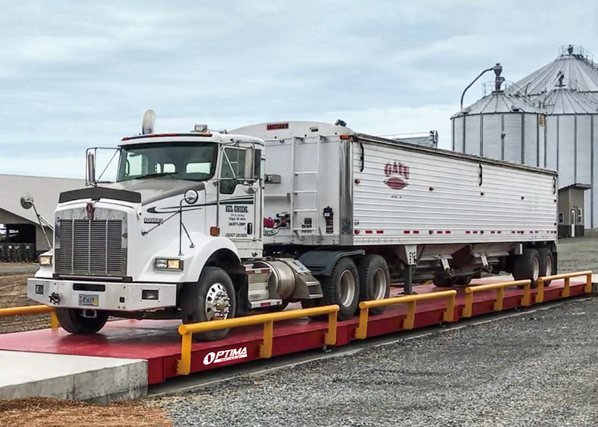
When you pull onto a CAT Scale, a perfect heavy load that meets CDL weight requirements looks like this:
- Steers: 12,000 lbs
- Drives: 34,000 lbs
- Trailer: 34,000 lbs
- Gross: 80,000 lbs
3. The Federal Bridge Formula (Simplified)
This is the most complex part of CDL weight requirements. Why does it exist? Bridges are designed to handle weight, but not concentrated weight. The formula forces you to spread the weight out over a longer distance.
The 36-Foot Rule (Inner Bridge)
To carry the full 68,000 lbs on your two tandem groups (34k + 34k), the distance between them (Inner Bridge) must be at least 36 feet. If you slide your trailer wheels too far forward and shorten this distance to 30 feet, your allowable weight drops.
4. How to "Scale Out" a Load: Sliding Tandems
You scaled your truck, and the ticket says:
- Drives: 36,500 (Overweight!)
- Trailer: 31,000 (Underweight)
You need to move weight from the Drives to the Trailer.
The Physics of Sliding
- Slide Wheels Forward: Puts more weight on the Trailer Axles.
- Slide Wheels Backward: Puts more weight on the Drives.
The "Hole" Rule of Thumb
1 Hole �250 to 500 lbs. To fix the problem above (2,500 lbs overweight on drives), you would slide the trailer wheels forward about 5-6 holes to shift weight onto the trailer.
Combination
Learn the 5-step coupling checklist and rollover prevention techniques.
5. Kingpin to Rear Axle (KPRA) Laws
Compliance with CDL weight requirements is also about length.
- California Rule: The center of the rear axle must be no more than 40 feet from the Kingpin.
- The Trap: If you slide your tandems all the way back to balance weight, you might become illegal on length in CA, FL, or CT.
Conclusion
Violating CDL weight requirements results in fines that are often paid by the driver. Always scale your load before leaving the shipper. A $13 scale ticket is cheaper than a $500 fine.
Explore More Practice Tests
General Knowledge
The #1 starting point. Covers vehicle inspections & basic road safety rules.
HazMat (H)
Master the placarding tables, shipping papers, and TSA requirements.
Air Brakes (L)
Memorize critical PSI numbers and the 3-step L.A.B. check process.
Combination
Learn the 5-step coupling checklist and rollover prevention techniques.
Pass Your CDL Exam First Try
Don't guess. Practice with 1000+ real exam questions updated for 2026.
Start Free Practice