
If you are confused by CDL license class types, you are not alone. Most people searching this topic are really asking a simple question: Do I need Class A, Class B, or Class C for the vehicle I want to drive?
The answer usually comes down to three things: total weight, trailer weight, and whether the vehicle carries passengers or placarded hazardous materials. This guide explains CDL classifications in plain English and gives you a chart you can use to sort out the right license fast.
Quick CDL Class Chart
| CDL Class | Basic Rule | Common Vehicles | Best Fit |
|---|---|---|---|
| Class A | Combination vehicle is 26,001+ lbs and trailer is over 10,000 lbs | Tractor-trailers, flatbeds, tankers, livestock haulers | Long-haul freight, regional routes, heavy hauling |
| Class B | Single vehicle is 26,001+ lbs, or it tows a trailer of 10,000 lbs or less | Dump trucks, buses, large box trucks, concrete mixers | Local delivery, transit, construction |
| Class C | Does not meet Class A or B weight rules, but carries 16+ passengers or placarded HazMat | Small buses, airport shuttles, HazMat vans | Passenger or specialty HazMat work |
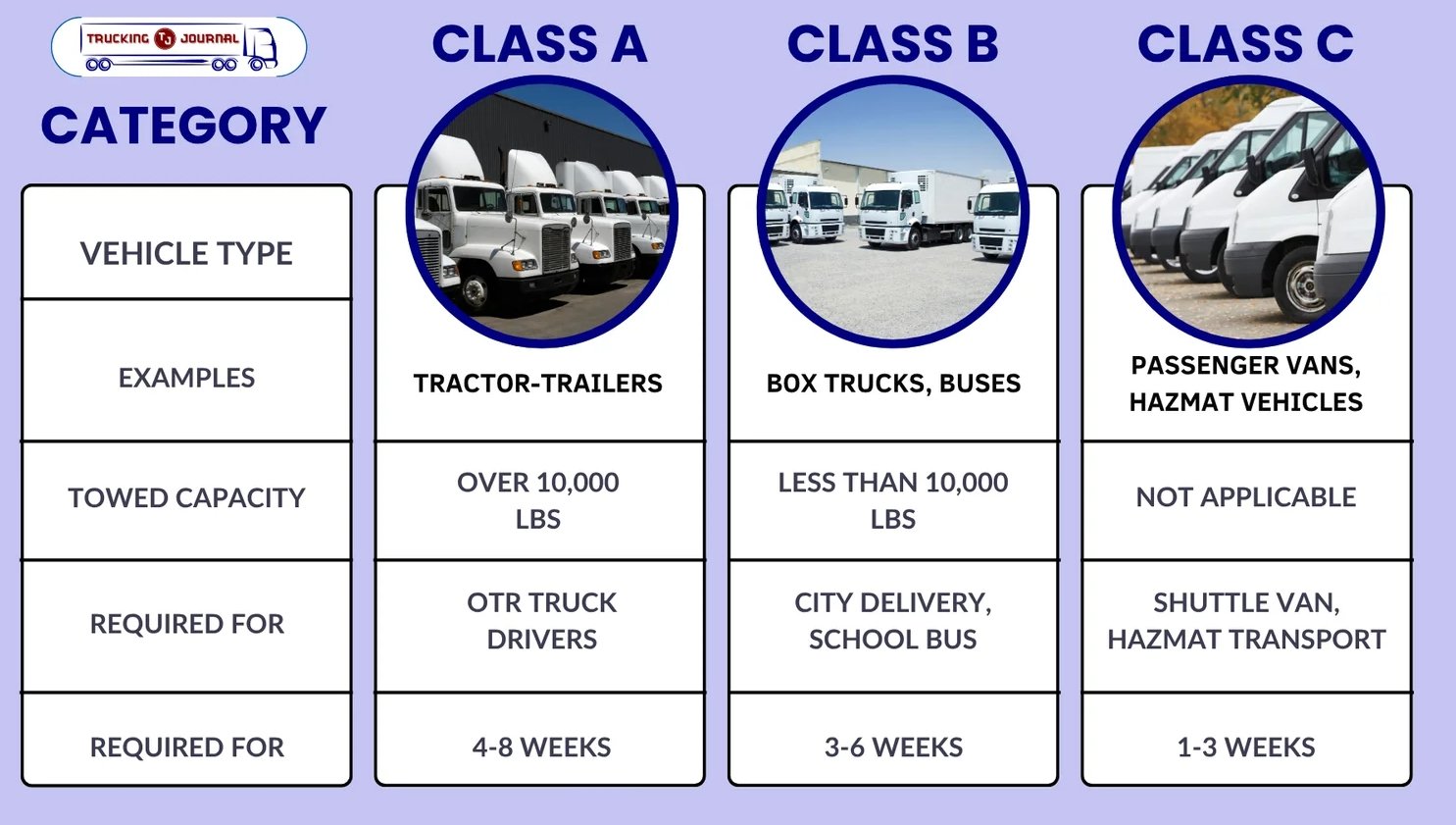
Class A vs Class B vs Class C: Quick Comparison
This is the fastest way to understand the CDL class breakdown.
| Question | Class A | Class B | Class C |
|---|---|---|---|
| Is weight the main trigger? | Yes | Yes | Usually no |
| Combination vehicle? | Yes, usually | Sometimes, but light trailer only | Usually not the key factor |
| Trailer over 10,000 lbs? | Yes | No | Not the defining rule |
| Passenger or HazMat trigger? | Can apply with endorsements | Can apply with endorsements | Usually the main reason this class is needed |
| Can it drive lower CDL classes? | Yes, with proper endorsements | Can usually drive Class C commercial vehicles with proper endorsements | No, not Class A or B vehicles |
If you are searching cdl class a/b/c, cdl class meaning, or different cdl licenses, this is the rule to remember:
- Class A is for heavy combinations.
- Class B is for heavy single vehicles.
- Class C is for passenger or placarded HazMat vehicles that stay below the Class A and B weight setup.
The Decision Tree: Which License Do You Need?
Ask these questions in order:
- Is the vehicle or combination rated at 26,001 lbs or more?
- If yes, is the trailer over 10,000 lbs?
- If no, does the vehicle carry 16 or more passengers including the driver, or placarded hazardous materials?
| Question | Answer | Result |
|---|---|---|
| 1. Is the vehicle or combination 26,001 lbs or more? | No | Go to passenger/HazMat question |
| Yes | Go to Question 2 | |
| 2. Is the trailer over 10,000 lbs? | Yes | Class A CDL |
| No | Class B CDL | |
| 3. Is it under A/B weight limits but carrying 16+ passengers or placarded HazMat? | Yes | Class C CDL |
| No | Usually non-CDL |
What Is a Class A CDL?
A Class A CDL applies to a combination vehicle with a Gross Combination Weight Rating (GCWR) of 26,001 lbs or more, as long as the towed vehicle is over 10,000 lbs.
Typical Class A vehicles:
- Tractor-trailers
- Flatbeds
- Tankers
- Livestock carriers
- Doubles and triples with proper endorsement
This is the class most people mean when they talk about a “big rig” license. It is also the most flexible CDL class because it can generally cover lower commercial classes when endorsements are in place.
What Is a Class B CDL?
Many users in the Bing keyword list are asking what is a class b cdl, class b cdl meaning, or class b cdl definition. The plain-English answer is:
A Class B CDL usually covers a single vehicle with a GVWR of 26,001 lbs or more, or that heavy vehicle towing a trailer of 10,000 lbs or less.
Typical Class B vehicles:
- Dump trucks
- Concrete mixers
- Garbage trucks
- Large box trucks
- City buses and school buses with endorsements
If you want to drive heavy local equipment without managing a heavy trailer, Class B is often the right fit.
Is a Class C License a CDL?
This is one of the biggest confusion points in the keyword report: is a class c license a cdl, class c is cdl, class c license vs cdl, and cdl license class c meaning.
The answer is: sometimes yes, sometimes no, depending on what “Class C” means in context.
Many states use Class C as the label for a regular non-commercial driver’s license. But CDL Class C is a separate commercial category. It usually applies when the vehicle:
- does not meet Class A or Class B weight rules, but
- carries 16 or more passengers including the driver, or
- transports placarded hazardous materials
That means a regular driver’s license called “Class C” is not the same thing as a CDL Class C.
When Do You Need Class B Instead of Class C?
Another strong search intent here is when do i need a class b instead of class c license. The easiest way to separate them is this:
- Class B is usually triggered by the weight of the vehicle itself.
- Class C is usually triggered by what the vehicle carries, not just weight.
Examples:
| Vehicle Scenario | Likely License |
|---|---|
| 28,000-lb box truck | Class B CDL |
| 24,000-lb shuttle bus carrying 20 passengers | Class C CDL |
| 23,000-lb HazMat delivery vehicle with placards | Class C CDL |
| 33,000-lb dump truck | Class B CDL |
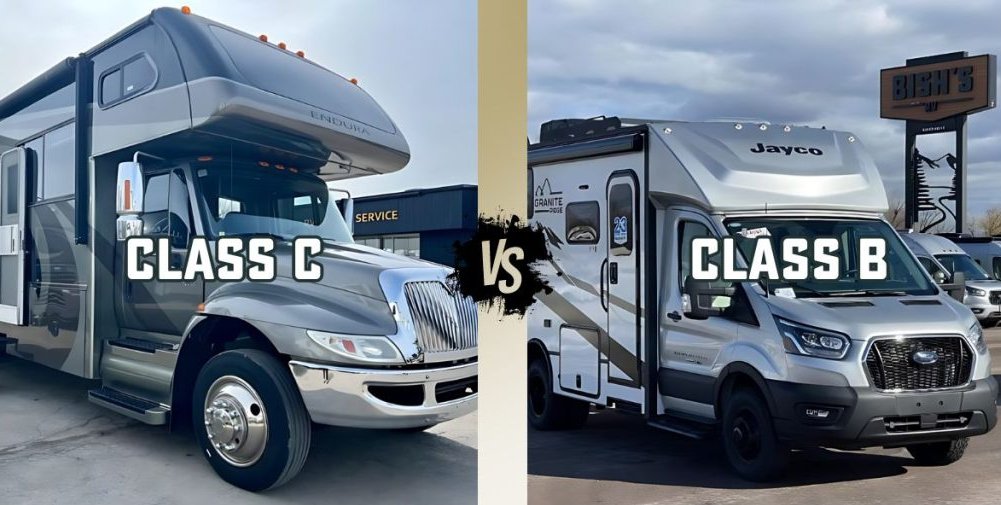
If you are trying to determine whether a box truck needs Class B or Class C, start with the GVWR. Large box trucks are usually a Class B question, not a Class C question.
What Vehicles Fit Each CDL Class?
Searches like truck class a b c cdl chart, what kind of driver’s license do you need to drive a big rig, and how to determine if a truck is class c or b all point to the same need: users want examples, not just definitions.
| Vehicle | Typical CDL Class |
|---|---|
| Tractor-trailer | Class A |
| Flatbed combination | Class A |
| Large dump truck | Class B |
| Big box truck | Class B |
| School bus | Class B or Class C, depending on weight, with endorsements |
| Airport shuttle | Class C if passenger threshold is met |
| Placarded HazMat van | Class C if below A/B weight limits |
When in doubt, look at the vehicle rating, then look at whether it has a heavy trailer, passengers, or placarded HazMat.
Can a Higher CDL Class Drive Lower Classes?
Yes, in most cases:
- A Class A CDL can usually operate Class B and Class C commercial vehicles.
- A Class B CDL can usually operate Class C commercial vehicles.
- A Class C CDL does not cover Class A or Class B vehicles.
The catch is endorsements. A driver still needs the correct Passenger (P), School Bus (S), HazMat (H), or other endorsements when the vehicle or job requires them.
5 Steps to Get Your CDL
No matter which class you choose, the process is similar.
- Check your age: You must usually be 18 for intrastate driving and 21 for interstate driving.
- Get your CLP: Pass the written permit tests. Class A applicants usually need General Knowledge, Air Brakes, and Combination Vehicles.
- Complete ELDT: Entry-Level Driver Training is required for first-time Class A or Class B applicants, and for certain upgrades or endorsements.
- Pass a DOT physical: You need a valid medical card for most CDL driving.
- Pass the skills test: This includes pre-trip inspection, backing/basic control, and an on-road drive.
Conclusion
The best way to understand CDL license classes explained is to simplify the question:
- Heavy combination with a trailer over 10,000 lbs: Class A
- Heavy single vehicle: Class B
- Lighter vehicle carrying passengers or placarded HazMat: Class C
If you are still deciding, use the chart first, then match your target vehicle to the examples above.
Frequently Asked Questions (FAQ)
What is the main difference between Class A and Class B CDL?
The biggest difference is the trailer rule. Class A usually applies when the combination is 26,001 lbs or more and the trailer is over 10,000 lbs. Class B usually applies to a heavy single vehicle or a heavy vehicle towing a lighter trailer.
What is a Class B CDL?
A Class B CDL usually covers a single vehicle with a GVWR of 26,001 lbs or more, or that heavy vehicle towing a trailer of 10,000 lbs or less.
Is a Class C license a CDL?
Sometimes. Many states use Class C for a regular non-commercial driver’s license, but CDL Class C is a commercial category for certain passenger or placarded HazMat vehicles that do not meet Class A or B weight rules.
Can I drive a Class B vehicle with a Class A license?
Yes. A Class A CDL generally allows you to drive Class B and Class C commercial vehicles too, as long as you have the required endorsements.
When do you need Class B instead of Class C?
You usually need Class B when the vehicle weight itself triggers the CDL. You usually need Class C when the vehicle stays under A/B weight limits but carries 16+ passengers or placarded HazMat.
What CDL class do you need for a box truck?
It depends on the GVWR. A large box truck rated at 26,001 lbs or more usually requires Class B CDL. A lighter box truck may not require a CDL unless another rule applies.