
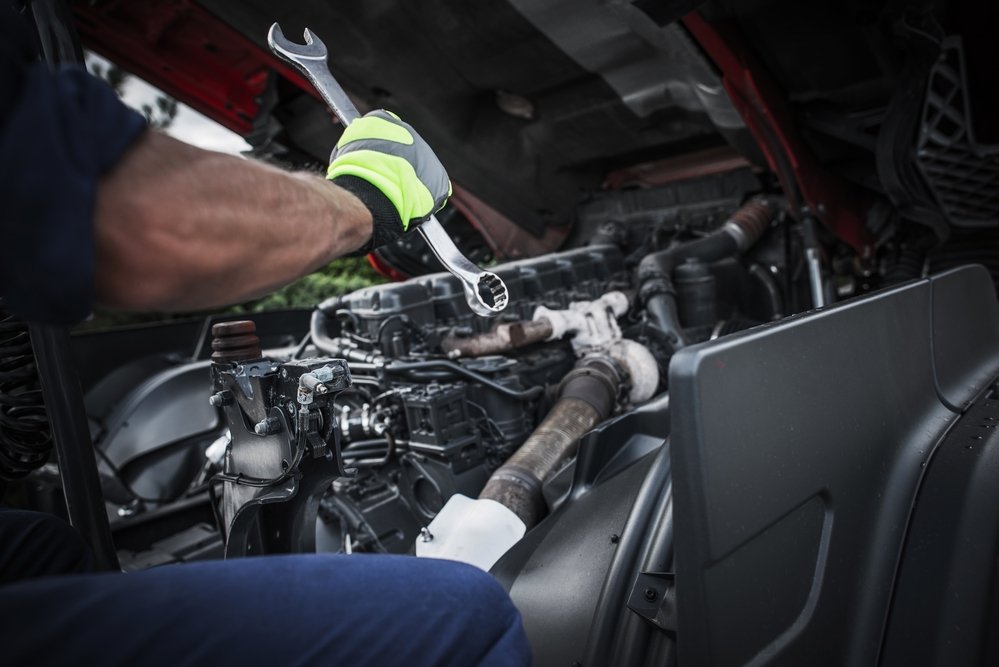
You’ve memorized the Checklist. You know the names of the parts. But can you answer the examiner’s specific questions about defects?
The Pre-Trip Inspection isn’t just about pointing; it’s about knowing what constitutes a failure. If a belt has 1 inch of play, is it good or bad? If a tire has 3/32” tread, is it legal?
Take this quiz to find out if you are ready for the real thing.
1. Engine & Under the Hood
1. You are checking the serpentine belt. You push on it and it deflects 1 inch. Is this acceptable?
A. Yes, up to 1 inch is fine.
B. No.
Correct Answer: B (No).
The Standard: Belts should have no more than 3/4 inch of play. 1 inch is too loose and indicates a defect. It could slip and cause the water pump or alternator to fail.
The Standard: Belts should have no more than 3/4 inch of play. 1 inch is too loose and indicates a defect. It could slip and cause the water pump or alternator to fail.
2. When checking the coolant level, you should:
A. Remove the radiator cap immediately.
B. Inspect the reservoir sight glass or remove the cap only when the engine is cool.
C. Wait for the engine to overheat.
Correct Answer: B.
Never remove a radiator cap on a hot engine; pressurized steam can burn you. Use the sight glass if available.
Never remove a radiator cap on a hot engine; pressurized steam can burn you. Use the sight glass if available.
2. Wheels & Tires (High Failure Rate)
3. You are inspecting a front steer tire. The tread depth measures 3/32 of an inch. Is this legal?
A. Yes, the minimum is 2/32.
B. No, the minimum is 4/32.
C. Yes, as long as the sidewalls are good.
Correct Answer: B (No).
Steer tires require a minimum of **4/32 inch** tread depth in every major groove. Drive and trailer tires only require **2/32 inch**. You would be placed Out-of-Service for this.
Steer tires require a minimum of **4/32 inch** tread depth in every major groove. Drive and trailer tires only require **2/32 inch**. You would be placed Out-of-Service for this.
4. Can you use re-grooved or re-treaded tires on the steer axle?
A. Yes.
B. No.
Correct Answer: B (No).
Bus drivers and truck drivers are prohibited from using regrooved, recapped, or retreaded tires on the front wheels (steer axle) for safety reasons.
Bus drivers and truck drivers are prohibited from using regrooved, recapped, or retreaded tires on the front wheels (steer axle) for safety reasons.
3. Brakes & Suspension
5. Brake linings (pads) must not be worn dangerously thin. What is the typical minimum thickness?
A. 1/2 inch.
B. 1/4 inch.
C. 1 inch.
Correct Answer: B (1/4 inch).
Generally, brake shoes should not be worn thinner than 1/4 inch at the center. Any thinner, and you risk metal-on-metal contact, which leads to brake failure.
Generally, brake shoes should not be worn thinner than 1/4 inch at the center. Any thinner, and you risk metal-on-metal contact, which leads to brake failure.
4. Coupling System
6. After coupling, there should be how much space between the upper and lower fifth wheel?
A. 1 inch.
B. No space.
C. 2 inches.
Correct Answer: B (No space).
There must be **no daylight** between the apron (trailer bottom) and the skid plate (5th wheel). If there is space, the trailer is not sitting flat and could disconnect or damage the kingpin.
There must be **no daylight** between the apron (trailer bottom) and the skid plate (5th wheel). If there is space, the trailer is not sitting flat and could disconnect or damage the kingpin.
Conclusion
If you missed any of these, you are not ready for the road test. The examiner will ask you specifics. Go back to the Checklist and memorize the numbers: 4/32, 2/32, 3/4 inch play, no daylight.