CDL Road Sign Test 2026: Visual Guide to Traffic & Highway Signs
Don't just read the guide. Test yourself with the actual questions likely to appear on your CDL test.
You have spent weeks memorizing the air brake leakage rates. You can recite the Pre-Trip Inspection in your sleep. You know exactly how much following distance you need at 55 MPH.
But then, you walk into the DMV, sit down at the computer, and a simple yellow diamond pops up on the screen. You hesitate. Is it a "Merge" sign? Or is it a "Lane Ends" sign?
You guess wrong. You fail.
It sounds ridiculous, but failing the General Knowledge exam because of the cdl sign test portion happens more often than you think.
For a Class D (car) driver, signs are suggestions. For a Class A (commercial) driver, signs are the law of physics. A "Steep Grade" sign for a car means "take your foot off the gas." For a truck driver, it means "if you don't downshift right now, your brakes will catch fire in two miles."
In this guide, we are going beyond the basics. We aren't just going to show you a Stop sign. We are going to break down the specific cdl road signs test questions that target truck drivers—clearances, weights, and hazards—and teach you how to read the road before it’s too late.
The Language of the Road: Shapes and Colors
Before we look at specific symbols, you need to master the grammar of road signs. The DMV loves to ask questions like: "What does a pennant-shaped sign indicate?"
If you don't know the answer immediately, you are in trouble.
The "Big Three" Categories
Regulatory (The Law): These tell you what you must or must not do.
- Colors: Red, White, Black.
- Shapes: Octagon (Stop), Inverted Triangle (Yield), Rectangle (Speed Limit/Restrictions).
- Trucker Note: "No Trucks Left Lane" or "Weight Limit 10 Tons" are regulatory. Ignore them, and you get a ticket.
Warning (The Hazards): These tell you what is coming up.
- Colors: Yellow background with Black symbols.
- Shape: Diamond.
- Trucker Note: This is the meat of the cdl sign test. Curves, grades, and height restrictions usually fall here.
Guide (The Directions): These tell you where you are going.
- Colors: Green (Highways), Blue (Services), Brown (Recreation).
- Shape: Rectangle.
The Special Shapes (Memorize These)
- Pennant (Flag shaped): Always on the left side of the road. Means No Passing Zone.
- Pentagon (House shaped): School Zone or School Crossing. Slow down.
- Round (Circle): Railroad Crossing approach. Look, Listen, and Live.
- Crossbuck (X): Actual Railroad Crossing.
The "Career Killers": Truck-Specific Signs
This is the section that separates the car drivers from the professionals. When you take your cdl signs test, these are the ones you cannot afford to miss—both on the screen and in real life.
1. Low Clearance (The Can Opener)
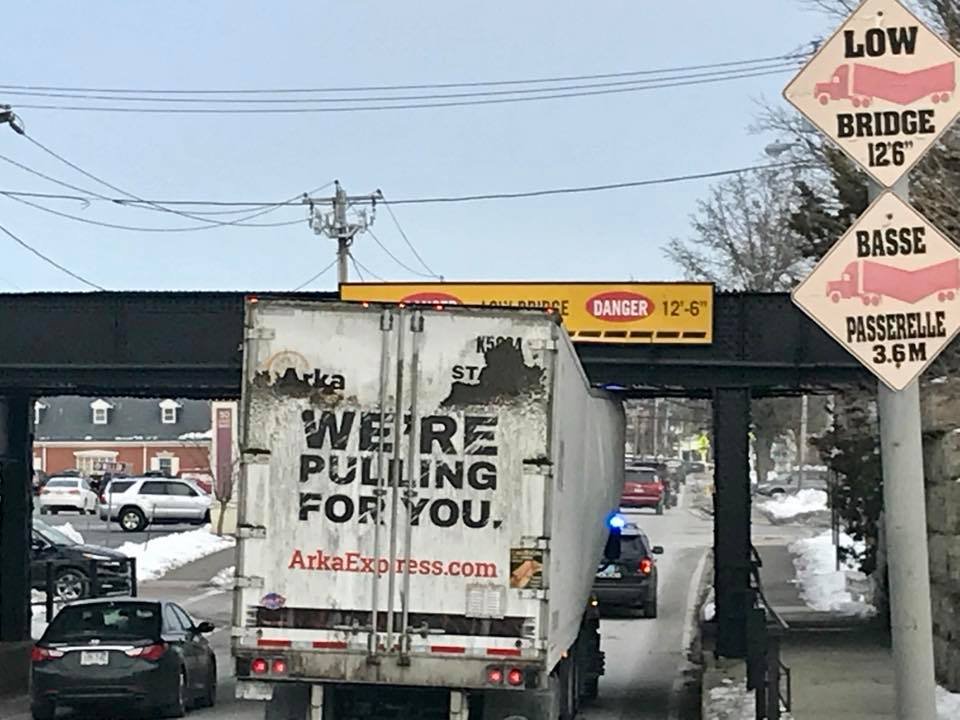
You will see a yellow diamond with arrows pointing up and down, and a number like "13' 6"".
- The Test Question: "What should you do if you see a sign indicating 12' 6" clearance?"
- The Reality: Most tractor-trailers are 13' 6" tall. If you see a sign that says 13' 6", you should be sweating. If it says 13' 5", you are stopping.
- Pro Tip: In snowy states like New York or Michigan, packed snow can reduce clearance by 2-3 inches. Never trust the sign blindly if it looks tight.
2. The Steep Grade (Percent Grade)
A yellow diamond showing a truck tipping forward on a triangle, often with a percentage (e.g., "6% Grade").
- The Meaning: A 6% grade means the road drops 6 feet for every 100 feet of length.
- The Test Question: "When should you downshift for a steep downgrade?"
- The Answer: Before you start down the hill. Once gravity takes over 80,000 lbs, you will never get that gear back. This sign is your cue to slow down immediately.
3. Lateral Wind / High Profile Vehicles
A yellow diamond showing a truck tipping over or a windsock.
- The Meaning: The area is prone to strong crosswinds.
- Why it Matters: An empty trailer is a sailboat. If you see this sign during a storm, and you are empty (deadheading), the safest move is to pull over and park.
4. Low Ground Clearance (The Hang-Up)
A yellow diamond showing a truck bottoming out on a railroad track.
- The Scenario: You are driving a lowboy or a car hauler.
- The Danger: If you try to cross a humped railroad crossing, your landing gear or fuel tanks will get stuck on the tracks. You are now a sitting duck for a train.
- Action: Find an alternate route.
Confusing Signs: Don't Get Tricked
The cdl road sign test is designed to trick you with signs that look similar. Here are the most common mix-ups.
Merge vs. Added Lane
- Merge: An arrow merging into the main line. This means traffic is squeezing together. You must yield or make room.
- Added Lane: Two arrows with a dotted line between them, continuing separately. This means entering traffic has their own lane. You do not need to move over (though it’s polite to do so).
Winding Road vs. Slippery When Wet
- Winding Road: A squiggly arrow. Means the road curves back and forth. Slow down.
- Slippery When Wet: A car with "skid marks" behind it. Means the road surface becomes slick in rain (often found on bridges or fresh asphalt).
Chevron Alignment
These are yellow rectangles with arrows > > > placed on the outside of a sharp curve.
- The Test Question: "What does a Chevron sign indicate?"
- The Answer: A sharp change in the direction of the road. It provides additional visibility for the curve.
Construction Signs: The Orange Zone
Construction signs are Orange with Black text. For road signs for cdl test purposes, remember this: Fines Double.
- The Flagger: A sign showing a person holding a flag or paddle. You must obey the flagger above all other signs or signals.
- Lane Closed Ahead: Usually shows a line ending. For a truck driver, you need to merge early. Do not be the guy waiting until the last inch to force your nose in—that causes accidents.
How to Study for the Visual Test
You can read about signs all day, but your brain processes images differently than text. To pass the cdl sign test, you need visual repetition.
1. The "Flashcard" Method Don't just look at the sign and the name. Look at the sign, close your eyes, and visualize the action you need to take.
- See "Weight Limit 10 Tons" -> Think "Check my bills, am I heavy?"
- See "No Trucks Left Lane" -> Think "Get right immediately."
2. Drive with Purpose (Even in your car) Next time you are driving your personal vehicle, play the game. Call out every sign you see. "Yellow Diamond, Pedestrian Crossing, slow down." "White Rectangle, Speed Limit 55." If you see a sign you don't recognize, pull over (safely) and look it up.
3. Watch Out for the "Not" Symbol The red circle with a slash through it means NO.
- A truck inside a red slash means No Trucks.
- A U-turn arrow inside a red slash means No U-Turn. It sounds obvious, but under testing pressure, people often misread "Truck Route" signs for "No Truck" signs because they glance too quickly.
Conclusion
The cdl sign test is not just a hurdle to clear at the DMV; it is a survival skill.
When you are driving a 70-foot long vehicle, you don't have the luxury of reacting at the last second. You need to know that the bridge ahead is 13' 4" before you are stuck under it. You need to know the grade is 7% before your brakes start smoking.
Don't let a simple shape or color be the reason you fail your General Knowledge exam. Study the shapes, respect the yellow diamonds, and remember: when in doubt, the sign is always right.
Ready to test your eyes? Try our visual practice quiz below and see if you can score 100%.
Air Brakes (L)
Memorize critical PSI numbers and the 3-step L.A.B. check process.
Explore More Practice Tests
General Knowledge
The #1 starting point. Covers vehicle inspections & basic road safety rules.
HazMat (H)
Master the placarding tables, shipping papers, and TSA requirements.
Air Brakes (L)
Memorize critical PSI numbers and the 3-step L.A.B. check process.
Combination
Learn the 5-step coupling checklist and rollover prevention techniques.
Pass Your CDL Exam First Try
Don't guess. Practice with 1000+ real exam questions updated for 2026.
Start Free Practice