Oregon CDL preparation starts with federal rules, but the application is completed through Oregon Driver & Motor Vehicle Services (DMV). Applicants must choose the correct class and endorsements, place valid medical certification on the DMV record, pass the required commercial knowledge tests, hold an Oregon commercial learner permit (CLP) for at least 14 days, complete Entry-Level Driver Training (ELDT) when required, and pass all three parts of the skills test.
This guide brings the Oregon-specific steps, current published fees, official handbook, testing rules, and practice modules into one place. Verify fees and appointment availability with Oregon DMV before paying a school or scheduling a vehicle.
2026 eligibility notice: Effective March 16, 2026, Oregon DMV says it no longer issues or reinstates limited-term (non-domiciled) CDLs and CLPs. Applicants affected by this policy should review the current DMV notice before beginning training.
Oregon CDL Quick Facts
| Item | Current Oregon requirement |
|---|---|
| Licensing agency | Oregon Driver & Motor Vehicle Services (DMV) |
| Minimum age | 18 for intrastate operation; 21 for non-excepted interstate commerce |
| Existing license | Hold an Oregon noncommercial Class C or higher driver license for a CLP |
| General driving experience | At least one year when applying for the CDL |
| Commercial learner permit | $40 |
| Commercial CDL | $160; REAL ID commercial CDL $190 |
| Commercial knowledge test | $10 for each test attempt |
| DMV commercial skills test | $145; third-party charges may vary |
| Minimum CLP holding period | 14 days before the skills test |
| Skills test | Vehicle inspection, basic control skills, and on-road driving |
| Test language | Commercial knowledge and skills tests are in English; translators are not permitted |
| Official handbook | Oregon Commercial Driver Manual |
Oregon requires proof of legal name, identity, date of birth, residence address, and U.S. citizenship or lawful permanent residence. You must provide your Social Security number, pass a vision screening, and have valid medical certification information recorded by DMV when your driving category requires it.
Which Oregon CDL Tests Do You Need?
Start with the vehicle and work you plan to perform. A Class A combination generally requires General Knowledge, Combination Vehicles, and Air Brakes if the vehicle uses air brakes. Class B applicants take General Knowledge plus tests required by their vehicle and endorsements. Passenger, school bus, tank, hazardous materials, and doubles/triples each add their own test or qualification.
Use the matching module instead of studying unrelated material:
- General Knowledge diagnostic — required foundation for CLP applicants.
- Air Brakes diagnostic — for air-brake-equipped vehicles; avoid an air-brake restriction.
- Combination Vehicles diagnostic — for Class A tractor-trailer combinations.
- Hazardous Materials diagnostic — supplement the manual before the separate federal threat-assessment process.
- Tanker diagnostic — for hauling liquids or gases in bulk.
- Doubles and Triples diagnostic — for Oregon routes and operations where multiple trailers are authorized.
- Pre-Trip Inspection diagnostic — preparation for the first part of the skills test.
Knowledge-test results are valid for six months. Oregon says HazMat and doubles/triples endorsements cannot be placed on a CLP, so distinguish tests needed for supervised practice from endorsements added to the final CDL.

Oregon CDL Application Steps
1. Confirm class, endorsements, and commerce type
Decide whether you need Class A, B, or C and whether the work is intrastate or interstate. Your self-certification affects medical requirements and operating restrictions. Oregon strongly recommends non-excepted interstate certification for drivers who meet federal qualifications and may work across state lines.
2. Put medical certification on your DMV record
Complete a DOT examination with a medical examiner listed on the National Registry of Certified Medical Examiners. Confirm that valid certification—and any required federal exemption, Skills Performance Evaluation, or state waiver—is actually recorded before the DMV transaction. A card in your wallet does not solve a missing DMV record.
3. Study the Oregon manual and pass the right knowledge tests
Use the manual’s “What Sections Should You Study?” table to map your class and endorsements to the correct chapters. Oregon commercial knowledge tests are offered in English only, translators are not permitted, and the published fee is $10 for each test. A failed attempt therefore costs both time and another fee.
4. Obtain the Oregon CLP
Bring the required identity, lawful-status, residence, and licensing documents; pass vision and required knowledge tests; and pay the $40 CLP fee. The permit authorizes supervised practice only in the class and endorsements shown on it.
When practicing, the supervising driver must be properly licensed for the vehicle and sit in the required position. Do not use a HazMat load during permit practice.
5. Complete ELDT when it applies
ELDT is required before the skills test for a first Class A or B CDL, a Class B-to-A upgrade, or first passenger or school bus endorsement. It must also be completed before the HazMat knowledge test for a first H endorsement. Use a provider listed in the FMCSA Training Provider Registry and confirm the completion record has posted before scheduling.
6. Hold the CLP for at least 14 days
The skills test cannot be taken early. Use the waiting period for repeated pre-trip explanations, backing exercises, coupling checks, brake inspections, and on-road practice—not only multiple-choice review.
7. Schedule the three-part skills test
Oregon permits testing through approved third-party CDL testers and at select DMV locations. The test includes:
- Vehicle inspection: identify components, explain what you inspect, and state why a defect matters.
- Basic control skills: demonstrate controlled backing and accurate vehicle placement.
- On-road driving: handle turns, intersections, railroad crossings, curves, multilane roads, and highways.
The test vehicle cannot carry a load, display hazardous-material placards, have more than one trailer, or be clearly unsafe or illegal. Skills results are valid for six months; finish the licensing requirements within that window.
8. Pay issuance fees and verify restrictions
Oregon currently publishes $160 for a commercial CDL and $190 for a REAL ID commercial CDL. Before leaving, verify the class, endorsements, medical status, and restrictions printed on the credential. A restriction caused by testing in the wrong vehicle configuration can limit the jobs you may accept.
Oregon Operating Conditions Worth Studying
Oregon testing is based on the commercial manual, but safe work also requires route-specific preparation:
- Mountain grades: choose a safe gear before descending and use proper braking technique; do not depend on repeated heavy service-brake applications.
- Winter chain controls: requirements change with signs, vehicle configuration, and conditions. Check ODOT Chains and Traction Tires and TripCheck before travel instead of relying on a single memorized chain count.
- Weight and route limits: confirm bridge, axle, length, and route restrictions for the actual combination through Oregon motor-carrier resources.
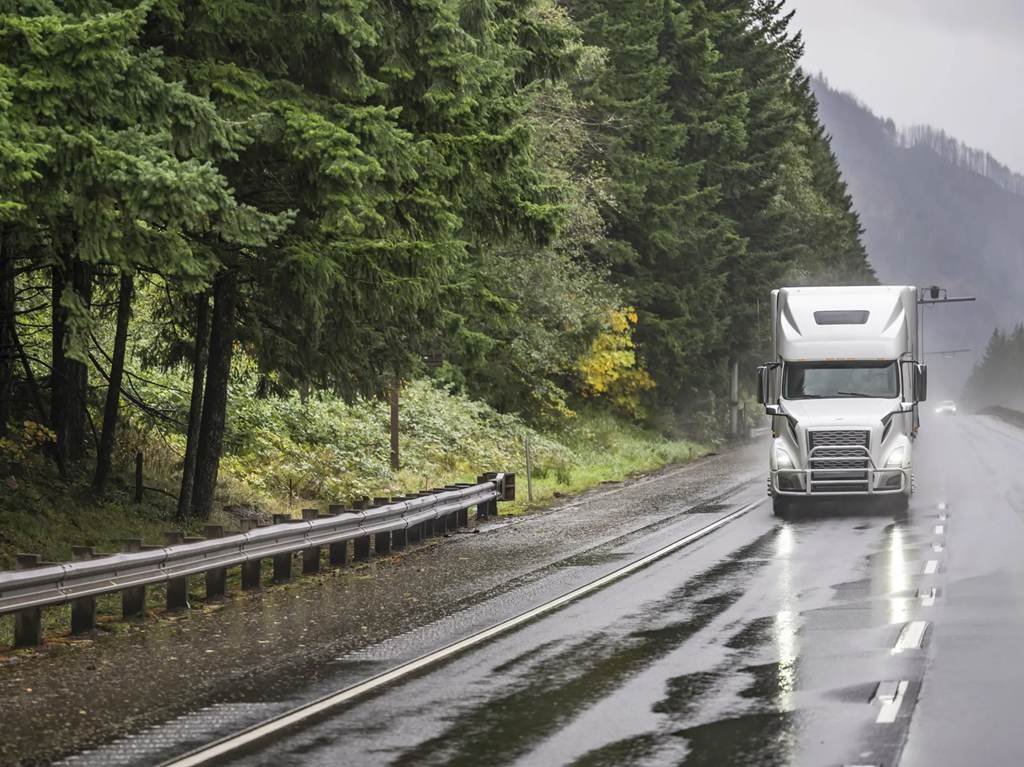
- Rain and reduced visibility: increase following distance, manage speed before curves, and watch for spray, standing water, and shifting traction.

How to Prepare Without Wasting Attempts
Read the relevant manual chapters once for structure, then take a matching diagnostic. Record weak topics—for example, air-loss limits, combination rollover risk, hazardous-material communication rules, or inspection terminology—and return to those exact sections. Retest after targeted review rather than memorizing answer positions.
For skills preparation, speak the inspection aloud. Name the component, describe its secure condition, identify leaks, cracks, wear, or contamination, and explain the safety consequence. Complete practice in a vehicle that matches the class, brake system, transmission, and endorsements you want on the final license.
Official Sources
- Oregon DMV — Getting a Commercial Driver License or CLP
- Oregon Commercial Driver Manual (PDF)
- Oregon DMV commercial license fees
- Oregon DMV manuals and publications
- ODOT chains and traction tires
- Oregon TripCheck road conditions
Oregon CDL FAQ
How much should I budget for DMV fees?
At the currently published rates, the CLP is $40, each commercial knowledge test is $10, a DMV commercial skills test is $145, and the commercial CDL is $160 ($190 for REAL ID). Retests, third-party testing, medical exams, training, endorsements, and vehicle rental can add to the total.
Can I take the Oregon commercial tests in another language?
No. Oregon DMV states that commercial knowledge and skills tests are in English and translators are not permitted.
How long do I need to hold the CLP?
At least 14 days before taking the CDL skills test. ELDT must also be complete first when it applies.
Where should I start studying?
Download the official Oregon Commercial Driver Manual, identify the chapters required for your class and endorsements, then use the corresponding diagnostic modules above to find weak areas before paying for repeated tests.
Build the license around the work you actually plan to do. Correct class selection, current medical status, targeted knowledge preparation, ELDT completion, and a matching test vehicle prevent the most expensive delays in the Oregon CDL process.