
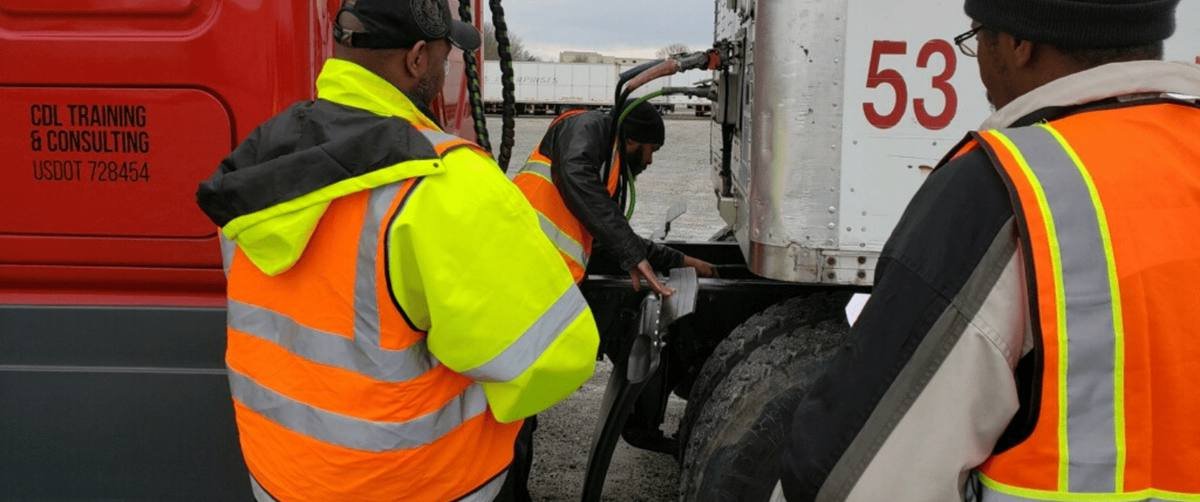
The CDL combination practice test is your final written hurdle before earning a Class A CDL. The Combination Vehicles exam is only 20 questions, but those 20 questions cover some of the most technical material in the entire CDL testing system. Coupling procedures, trailer air systems, fifth wheel inspections, and jackknife prevention are not topics you can guess your way through.
You need to score 80 percent (16 out of 20) to pass. Miss five questions and you are coming back another day. This guide gives you the knowledge and the practice questions to pass on your first attempt.
1. What the Combination Vehicles Test Covers
The CDL combination practice test material comes directly from Section 6 of the CDL manual. The exam covers five main topic areas:
- Coupling and uncoupling: The step-by-step process of connecting and disconnecting a tractor from a trailer
- Fifth wheel and kingpin: How the physical connection works, inspection points, and safety checks
- Trailer air systems: Service lines, emergency lines, glad hands, and trailer air tanks
- Combination vehicle handling: Off-tracking, jackknife prevention, and braking dynamics
- Pre-trip inspection for combinations: What to check on the coupling, air connections, and landing gear
Let’s break down each area and then test your knowledge with practice questions.
2. Coupling: How to Connect a Tractor to a Trailer
Coupling is the physical process of attaching your tractor to the trailer. The CDL combination practice test will ask you about the correct sequence and safety checks.
The Coupling Sequence
- Inspect the fifth wheel: Check for damage, grease, and proper jaw position. The fifth wheel should be tilted slightly toward the rear. Make sure the mounting bolts are tight.
- Inspect the kingpin: Look for cracks, bends, or excessive wear. The kingpin is the steel pin on the front of the trailer that locks into the fifth wheel.
- Position the tractor: Back the tractor slowly toward the trailer. Stop when the fifth wheel is just below the trailer apron. Check that the trailer height is correct (the apron should be slightly above the fifth wheel).
- Back under the trailer: Reverse slowly until the fifth wheel jaw locks around the kingpin. You will hear and feel the lock engage.
- Perform the tug test: Put the tractor in low gear and gently pull forward against the trailer with the trailer brakes locked. If the coupling holds, the kingpin is locked. If the trailer slides off the fifth wheel, stop immediately and recouple.
- Connect air and electrical lines: Attach the glad hands (service and emergency), connect the electrical cord, and raise the landing gear.
- Verify air connections: Build air pressure in both systems and check for leaks.
The Uncoupling Sequence
Uncoupling is the reverse, but with specific safety steps:
- Position the rig on level, solid ground
- Lower the landing gear until it contacts the ground
- Disconnect the air lines and electrical cord
- Pull the fifth wheel release handle
- Slowly pull the tractor forward away from the trailer
The tug test confirms that the fifth wheel locking jaw has properly engaged the kingpin. You apply the trailer brakes (so the trailer cannot roll), put the tractor in a low gear, and gently pull forward. If the connection holds, the coupling is secure. This is a critical safety step covered in every **CDL combination practice test**.
3. Fifth Wheel and Kingpin: The Connection Point
The fifth wheel is the large metal plate mounted on the rear of the tractor frame. The kingpin is the steel pin hanging down from the bottom of the trailer. When these two connect, your tractor and trailer become a single unit.
Key Inspection Points
- Fifth wheel plate: Should be greased and free of cracks or bends
- Locking jaw: Must fully close around the kingpin with no visible gap
- Release arm: Should be in the locked position (usually a safety latch or pin secures it)
- Fifth wheel mounting: Bolts should be tight, no cracks in the mounting brackets
- Kingpin: No cracks, bends, or excessive wear. The kingpin should be uniform in diameter
- Trailer apron: The flat plate around the kingpin should sit flat on the fifth wheel surface
A common CDL combination practice test question asks what to do if the trailer is too high or too low when coupling. The answer: if the trailer is too high, lower the landing gear. If it is too low, raise the landing gear. Never force the tractor under a trailer that sits at the wrong height. This damages the fifth wheel and can create an unsafe coupling.
4. Trailer Air Systems: Service vs. Emergency
The trailer air system is the most technically complex topic on the CDL combination practice test. You need to understand two separate air lines and how they interact with the trailer brakes.
Service Air Line
- Color code: Blue glad hand
- Function: Controls the trailer brakes during normal driving
- How it works: When you press the brake pedal, air pressure flows through the service line to the trailer relay valve, which applies the trailer brakes in proportion to your pedal input
- Key point: The service line only sends air when you actively press the brake pedal
Emergency Air Line
- Color code: Red glad hand
- Function: Supplies constant air pressure to the trailer air tanks and keeps the trailer spring brakes released
- How it works: As long as air pressure is maintained in the emergency line, the trailer spring brakes stay released. If pressure drops (line break, glad hand disconnect), the spring brakes automatically engage and stop the trailer
- Key point: The emergency line is always pressurized during normal driving. It is your fail-safe
Glad Hands
Glad hands are the quick-connect couplers that join the tractor air lines to the trailer air lines. They have rubber seals (called glad hand seals or grommets) that prevent air leaks. Before connecting glad hands:
- Inspect the rubber seals for cracks or damage
- Clean any dirt or debris from the connection surfaces
- Match the colors: blue to blue (service), red to red (emergency)
- Press firmly and twist to lock the connection
A common CDL combination practice test question involves what happens when glad hands are connected incorrectly (service to emergency or vice versa). The answer: the trailer brakes may not function correctly, and you could lose braking ability on the trailer. Always match colors.
If the emergency air line loses pressure (from a line break, glad hand disconnect, or system failure), the trailer spring brakes automatically engage. This is the fail-safe design. Spring brakes are held in the released position by air pressure from the emergency line. When that pressure is lost, the mechanical springs force the brake shoes against the drums. This is a core concept on the **CDL combination practice test**.
5. Jackknife Prevention
A jackknife is one of the most dangerous situations for a combination vehicle driver. It occurs when the trailer swings out of alignment with the tractor, forming a V or L shape. Once a full jackknife develops, it is almost impossible to recover from.
Two Types of Jackknife
- Trailer jackknife: The trailer swings out to one side while the tractor stays straight. This is the more common type.
- Tractor jackknife: The tractor’s drive wheels lock up and the tractor swings around. This is less common but more dangerous.
Prevention Techniques
- Maintain following distance. More space means more time to react and less need for panic braking.
- Brake before turns, not during turns. Heavy braking in a turn shifts weight and can cause the trailer to push the tractor sideways.
- Use gentle steering inputs. Jerky steering on slick surfaces can cause the trailer to start swinging.
- Watch your mirrors constantly. If you see the trailer starting to drift, correct early before it develops into a full jackknife.
- Adjust speed for conditions. Rain, snow, ice, and even high winds can trigger a jackknife at speeds that are perfectly safe in dry conditions.
Recovery (If Caught Early)
If you feel the trailer starting to jackknife:
- Release the brakes immediately (do NOT brake harder)
- Accelerate slightly to pull the trailer back into alignment
- Steer gently in the direction of the skid to straighten the combination
- Once aligned, gradually reduce speed
6. Off-Tracking and Combination Vehicle Dynamics
Off-tracking is the reason a semi-truck takes a different path through a turn than a passenger car. The rear wheels of the trailer follow a shorter path than the front wheels of the tractor, cutting the corner.
Why It Matters
- On right turns, the trailer rear wheels may jump the curb or encroach on the sidewalk
- On left turns, the trailer may cross into oncoming lanes
- On tight roads, off-tracking can put the trailer into parked cars, poles, or ditches
How to Handle Off-Tracking
- Right turns: Swing wide to the left before the turn, then cut right so the trailer tracks cleanly through the turn without jumping the curb
- Left turns: Position yourself in the right portion of the left-turn lane to give the trailer room to track
- Always check mirrors during turns to monitor where the trailer is tracking
The CDL combination practice test often asks about off-tracking distances. A general rule: a 53-foot trailer can off-track 3 to 5 feet on a tight 90-degree turn.
If the trailer starts to jackknife, release the brakes immediately and apply slight acceleration to pull the tractor and trailer back into alignment. Braking harder increases the forces causing the jackknife. Sharp steering inputs make the situation worse. The key is to regain forward momentum and gently steer to correct the alignment.
7. Pre-Trip Inspection for Combination Vehicles
The combination vehicle pre-trip inspection adds several checkpoints beyond what a single-vehicle inspection requires:
Coupling Inspection
- Fifth wheel mounting: bolts tight, no cracks
- Fifth wheel plate: properly greased, no visible damage
- Kingpin lock: visually confirm the jaw is fully closed
- Release arm: secured in locked position
- Air lines: connected, no leaks, no kinks or abrasion
- Electrical cord: plugged in, no damaged wires
Trailer Inspection
- Landing gear: fully raised, handle secured, no cracks in support legs
- Trailer frame: no cracks, bends, or loose cross members
- Trailer brakes: check slack adjusters, brake chambers, drums
- Trailer tires and wheels: tread depth, lug nuts, inflation, valve stems
- Trailer lights: tail lights, brake lights, turn signals, clearance lights, reflectors
- Cargo securement: load properly blocked, braced, and tied down
8. Key Numbers to Memorize
The CDL combination practice test includes several questions that require knowing specific numbers. Here are the ones that show up most often:
- Combination test passing score: 80% (16 of 20 questions)
- Number of air lines on a standard trailer: 2 (service and emergency)
- Emergency brake application pressure: Spring brakes engage when emergency line pressure drops to approximately 20-45 psi
- Glad hand color coding: Blue = service, Red = emergency
- Maximum trailer length (federal): 53 feet (most states)
- Fifth wheel grease: Should be a thin, even coat. Too much attracts dirt and debris
The blue glad hand connects the service air line, which controls the trailer brakes during normal driving. The red glad hand connects the emergency air line, which keeps the trailer spring brakes released. This color coding is standardized across North America and appears frequently on the **CDL combination practice test**.
Conclusion
The CDL combination practice test material is all about understanding how the tractor and trailer work together as a system. Coupling sequences, air line connections, fifth wheel inspections, and jackknife prevention are not abstract concepts. They are the skills you will use every single day as a Class A driver.
Study Section 6 of the CDL manual thoroughly. Memorize the coupling and uncoupling sequences step by step. Understand the difference between service and emergency air lines. Know what off-tracking is and how to manage it. And practice with our quiz questions until you can answer every one without hesitation.
For more preparation, start with our Free CDL Practice Test for General Knowledge and Air Brakes. Then move to our Class A CDL Practice Test for the full Class A exam set. For air brake specifics, review our CDL Air Brake Test Questions and Answers.
Frequently Asked Questions (FAQ)
How many questions are on the CDL Combination Vehicles test?
The CDL Combination Vehicles knowledge test has 20 questions. You must answer at least 16 correctly (80 percent) to pass. The test is required only for Class A CDL applicants. This is a separate exam from General Knowledge and Air Brakes.
What is the correct coupling sequence for a tractor-trailer?
The correct coupling sequence is: inspect the fifth wheel and kingpin for damage, position the tractor in front of the trailer, back slowly under the trailer until the fifth wheel locks around the kingpin, perform a tug test to verify the coupling is secure, connect the air lines and electrical cord, and raise the landing gear. The CDL combination practice test frequently tests this sequence.
What is a jackknife and how do you prevent it?
A jackknife occurs when the trailer swings out of alignment with the tractor, forming a V shape. Prevent it by maintaining proper following distance, braking before turns instead of during them, using gentle steering inputs, and adjusting speed for road conditions. If a jackknife starts, release the brakes and accelerate slightly to regain alignment.
What is the difference between service and emergency air lines?
The service air line (blue glad hand) controls the trailer brakes during normal driving when you press the brake pedal. The emergency air line (red glad hand) supplies constant air pressure to keep the trailer spring brakes released. If the emergency line loses pressure, the trailer spring brakes automatically engage as a fail-safe.
What are glad hands on a combination vehicle?
Glad hands are the quick-connect coupler fittings that join the tractor air lines to the trailer air lines. They have rubber seals to maintain an airtight connection. The blue glad hand connects the service line and the red glad hand connects the emergency line. Always match colors when connecting.
Do I need to take the Combination Vehicles test for a Class B CDL?
No. The Combination Vehicles knowledge test is required only for the Class A CDL. Class B and Class C CDL applicants do not take this exam. This makes the CDL combination practice test a Class A exclusive requirement.