
You have been driving trucks in Mexico for twelve years. You know air brakes, you know cargo securement, you know mountain grades. You move to Houston and apply for a Texas CDL. You pass the written General Knowledge test in Spanish with a 94%. Then you show up for the road test and the examiner says, “Point to the slack adjuster and tell me what you are checking.” You know exactly what it does but the word “slack adjuster” does not exist in your vocabulary. You fail on the spot.
This is the gap that catches thousands of experienced bilingual drivers every year. The CDL English requirements under federal law do not demand fluency. They demand functional proficiency - enough to talk to a DOT officer, read a road sign, and name truck parts during a Pre-Trip inspection. But the gap between “I can read the manual in Spanish” and “I can pass the English-only road test” is where people get stuck.
This guide explains exactly what FMCSA 49 CFR 391.11 requires, where the enforcement happens, and how ESL drivers can bridge the gap without spending months in an English classroom.
The Federal Law: 49 CFR 391.11(b)(2)
The CDL English requirements are not a suggestion. They are federal law, and enforcement has increased significantly since 2024. The regulation states:
“Can read and speak the English language sufficiently to converse with the general public, to understand highway traffic signs and signals in the English language, to respond to official inquiries, and to make entries on reports and records.”
That sentence contains four distinct requirements. Let me break them down.
1. Converse with the General Public
You must be able to give and receive directions, answer questions from a fuel station attendant, and communicate with a shipping dock worker. You do not need perfect grammar. You need to be understood and to understand.
2. Understand Highway Traffic Signs and Signals
You must recognize and respond to English-language road signs in real time. “Lane Ends Merge Left,” “Low Clearance 12’6”,” “Weigh Station 1 Mile,” “Steep Grade Trucks Use Lower Gear” - these are not negotiable. If you blow past a low clearance sign because you did not understand it, you will hit a bridge.
3. Respond to Official Inquiries
When a DOT officer at a weigh station asks “Where are you coming from? What are you hauling? Let me see your bills of lading,” you must understand the questions and respond coherently. Staring blankly or handing over documents without answering is a violation.
4. Make Entries on Reports and Records
You must be able to fill out a logbook, complete a vehicle inspection report, and write basic information on shipping documents in English. This does not mean perfect spelling - it means legible and accurate.
Where the CDL English Requirements Are Tested
The law is tested in three places. Understanding where helps you prepare for the right situations.
At the DMV: The Skills Test and Pre-Trip Inspection
This is where most ESL drivers fail the CDL English requirements. The Pre-Trip inspection is an English-only test. You walk around the truck with the examiner and identify components out loud.
No translators allowed. No family members, no bilingual friends, no interpreter services. You and the examiner, in English, for the entire test.
The examiner listens for specific technical vocabulary. You do not need to recite paragraphs. You need to:
- Name the part: “This is the air compressor.”
- State what you are checking: “I am checking that it is securely mounted.”
- Give the condition: “Not cracked, bent, or broken. No audible air leaks.”
That pattern repeats for every component on the truck. If you can memorize those three sentences for each part, you can pass the Pre-Trip even with limited conversational English.
At the Written Test: Your Language Advantage
Here is the good news: many states allow you to take the written CDL knowledge tests in other languages. States that commonly offer Spanish-language testing include Texas, California, Florida, Illinois, New Jersey, New York, and Arizona.
You can take General Knowledge, Air Brakes, and Combination Vehicles in Spanish. You can study from a Spanish-language CDL manual. You can even complete the ELDT theory course in Spanish through many FMCSA-approved online providers.
The CDL English requirements only apply to the road test, the Pre-Trip inspection, and real-world driving. The written test is a knowledge check, and many states recognize that the physics of air brakes do not change based on language.
On the Road: DOT Inspections and Weigh Stations
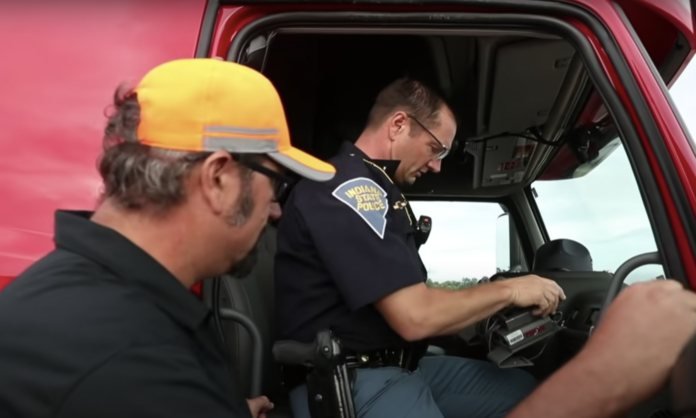
This is where the stakes are highest. A DOT officer at a weigh station in Pennsylvania, Indiana, or any other state can test your English proficiency during a routine inspection. If the officer determines you cannot communicate well enough to operate safely, the consequences are immediate:
- Violation citation for 391.11(b)(2)
- Out-of-Service order - your truck stays parked until a qualified driver takes the wheel
- Potential CDL downgrade for repeated violations
FMCSA has directed enforcement officers to increase English proficiency checks since 2024. This is not theoretical - drivers are being pulled out of service for this specific violation.
The Pre-Trip Vocabulary You Must Memorize
For ESL drivers, the fastest path to passing the CDL English requirements is memorizing the specific truck part names. You do not need an English class. You need a flashcard deck.
Under the Hood (Engine Compartment)
- Alternator
- Air compressor
- Water pump
- Oil dipstick
- Fan belt / drive belt
- Power steering fluid
- Coolant reservoir
Brakes and Suspension
- Brake chamber
- Slack adjuster
- Pushrod
- Brake drum
- Brake linings / brake pads
- Leaf spring
- Air bag / air spring
- Shock absorber
Coupling System (Class A)
- Fifth wheel skid plate
- Kingpin
- Locking jaws
- Gladhands (air line connectors)
- Electrical cord / seven-way plug
- Trailer air supply valve
Steering and Tires
- Steering box
- Tie rod
- Pitman arm
- Lug nuts
- Valve stem
- Tread depth
The Magic Phrase
For almost every component on the truck, you will say the same thing:
“Not cracked, bent, or broken. Securely mounted. No visible leaks.”
Memorize this sentence. Say it out loud 50 times. When you are standing next to the truck on test day with the examiner watching, this phrase needs to come out of your mouth without thinking.
The Spanglish Method: Study in Spanish, Test in English
Thousands of bilingual drivers pass the CDL English requirements every year using a simple two-step method:
Step 1: Study the concepts in your native language. Read the Air Brakes chapter in the Spanish CDL manual. Actually understand how the governor works, what the dual air system does, and why the low air warning triggers at 60 PSI. The concepts are what matter - the language of the answer is just vocabulary.
Step 2: Learn the English truck part names with flashcards. Take the English CDL manual, open it to the same chapter, and make flashcards with the Spanish term on one side and the English name on the other. Practice saying each part name out loud in English until it feels natural.
Step 3: Practice the Pre-Trip script out loud. The Pre-Trip is a spoken test, not a written one. Stand next to a truck (or look at diagrams) and practice naming every part in English. Say the magic phrase for each one. Do this until the English words come out of your mouth without translating in your head first.
Practice Questions (CDL English Requirements)
The road test and Pre-Trip inspection are English-only under FMCSA rules. No translators or interpreters are allowed. If you cannot understand the examiner's instructions, you cannot safely operate the vehicle and you will fail.
Under the **CDL English requirements**, the officer can cite you for failing to respond to official inquiries and place your vehicle Out of Service. Repeated violations can lead to CDL suspension. DOT officers are not required to provide translators.
The Pre-Trip inspection is an English-only test. You must name the part in English. Study the concepts in Spanish if it helps you understand, but practice saying every truck part name in English before test day.
Conclusion
The CDL English requirements are not about discrimination. They are about safety. A driver who cannot read a “Low Clearance” sign or understand a DOT officer’s questions is a danger to themselves and everyone else on the road. FMCSA 391.11 sets a functional standard - not fluency, not perfection, just enough English to operate safely.
If you are an ESL driver, use the Spanglish Method. Study the concepts in your native language. Then learn the English truck part names with flashcards and practice the Pre-Trip script out loud until the words come naturally. Take the written test in Spanish if your state allows it. But walk into the road test knowing that the Pre-Trip, the driving instructions, and real-world DOT inspections will all be in English.
For more help preparing, try our Free CDL Practice Test to test your knowledge. If you need the CDL manual in another language, check our CDL Manual in Spanish guide for download links and study strategies.
Frequently Asked Questions (FAQ)
Is there a specific CDL English test?
No. There is no written English proficiency exam like TOEFL for the CDL. However, the CDL English requirements are tested through the road skills test and Pre-Trip inspection, both of which must be conducted entirely in English. If you cannot understand the examiner or name truck parts in English, you will not pass.
Can I take the CDL written test in Spanish?
Yes. States including Texas, California, Florida, Illinois, New Jersey, New York, and Arizona offer the written knowledge tests (General Knowledge, Air Brakes, Combination Vehicles) in Spanish at most DMV locations. But the road test and Pre-Trip inspection remain English-only in every state.
What happens if a DOT officer determines I cannot speak enough English?
The officer can cite you for violating 49 CFR 391.11(b)(2) and place you Out of Service immediately. Your truck stays parked until a qualified driver takes the wheel. You may also face points on your CDL record. Repeated violations can result in CDL suspension.
Can I use an interpreter during the CDL road test?
No. Federal law prohibits any interpreter, translator, or bilingual companion during the CDL skills test and road test. The examiner gives instructions in English and you must understand and respond in English throughout the entire test.
What English words do I need to know for the Pre-Trip inspection?
You must name every truck part in English. The most critical terms are: alternator, air compressor, brake chamber, slack adjuster, pushrod, brake drum, brake linings, leaf spring, fifth wheel, kingpin, locking jaws, gladhands, steering box, and tie rod. The phrase “Not cracked, bent, or broken” is repeated for almost every component.
Does the CDL English requirement apply to Canadian drivers?
Yes. Any driver operating a commercial motor vehicle in the United States must meet the FMCSA English proficiency standard under 49 CFR 391.11, regardless of citizenship or country of origin. Canadian drivers entering the US are subject to the same enforcement at DOT inspection stations.