
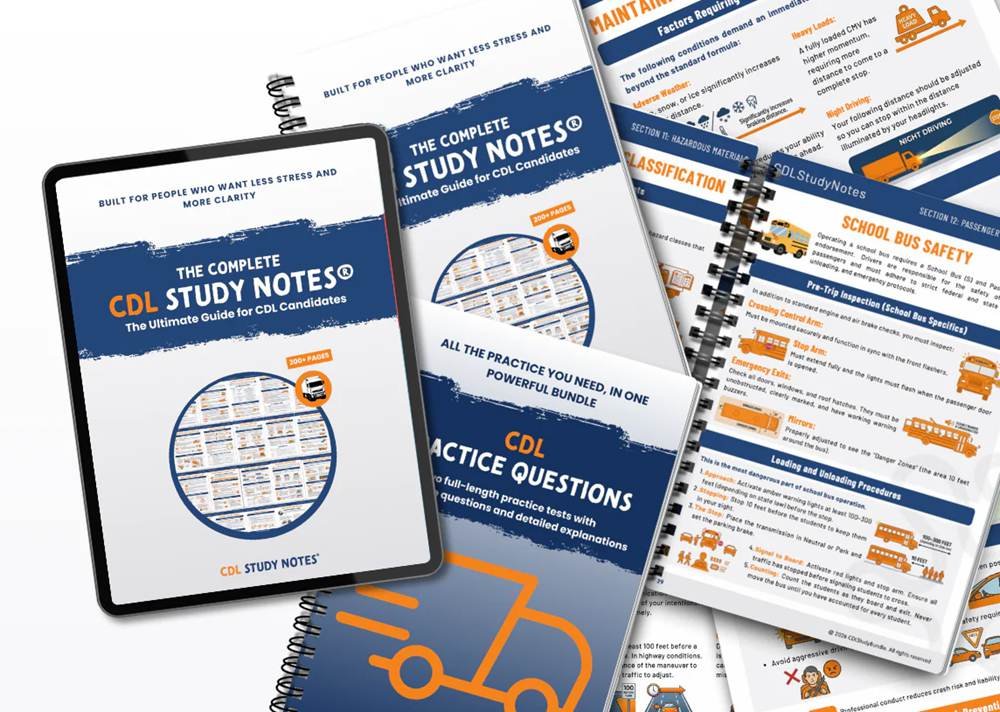
If you are looking for free CDL test questions and answers printable study pages, this guide is built for exactly that. It gives you a printable set of CDL practice questions, short answer explanations, a key numbers cheat sheet, and a simple way to save everything as a PDF for offline study.
This page focuses on the parts of the permit exam most people search for first: CDL test questions and answers, printable CDL practice test pages, CDL questions and answers PDF style review, and a free printable CDL study guide you can use at home, in the truck, or during breaks at school.
If you searched for cdl practice test printable free resources or a cdl practice test 2026 packet you can print and reuse, this page is meant to cover that same need in one place.
The main emphasis is General Knowledge, because that is the section most first-time CDL permit applicants take first. You will also get Air Brakes and Combination Vehicles questions, plus a short answer key workflow so you can print, cover the answers, and score yourself fast.
Press Ctrl+P (or Cmd+P on Mac) any time to print this full page.
Free Printable CDL Practice Test With Answers
This page is designed to work as a free printable CDL practice test with answers. You can print it as-is, cover the explanation blocks, answer each question on paper, and then use the explanations as your answer key.
It is especially useful if you are searching for:
- printable cdl practice test
- printable cdl test and answers
- free printable cdl practice test
- cdl practice test with answers
- cdl practice test answer key
If you want a printable packet, the best order is:
- Print the key numbers section first.
- Print the General Knowledge questions next.
- Save the full page as a PDF if you want a reusable digital copy.
Find the module your printout cannot diagnose
Printed questions help recall, but repeating the same sheet can hide memorized answers. Take a fresh 10-question General Knowledge diagnostic to expose weak topics. If you need broader coverage, the complete app contains 1,500+ questions across every CDL module.
Check My General Knowledge →The Key Numbers Cheat Sheet
Print this table first. These numbers appear on virtually every CDL exam in the country. If you memorize nothing else, memorize every row in this table.
| Item | The Number | What It Means |
|---|---|---|
| CDL GVWR Threshold | 26,001 lbs | Any single vehicle over this weight requires a CDL |
| Class A Trailer Threshold | 10,001+ lbs | Towed trailer over this weight makes it a Class A combination |
| Governor Cut-In | ~100 psi | Compressor starts pumping when pressure drops to this level |
| Governor Cut-Out | ~125 psi | Compressor stops pumping - tanks are fully charged |
| Safety Relief Valve | 150 psi | Opens to prevent tank rupture if governor fails |
| Low Air Warning | 60 psi | Buzzer and light must activate before pressure drops here |
| Spring Brake Engagement | 20-45 psi | Emergency/parking brakes automatically apply in this range |
| Leak: Straight Truck (applied) | 3 psi/min | Max pressure loss with brakes pressed, engine off |
| Leak: Combination (applied) | 4 psi/min | Max pressure loss for tractor-trailer, brakes pressed |
| Steer Tire Tread | 4/32 inch | Minimum legal tread depth on front (steering) tires |
| Drive/Trailer Tire Tread | 2/32 inch | Minimum legal tread depth on all other tires |
| Following Distance | 1 sec / 10 ft | Add 1 extra second for speeds over 40 mph |
| CDL BAC Limit | 0.04% | Legal limit in a CMV (half the 0.08% personal car limit) |
| Brake Lag Distance (55 mph) | ~32 feet | Time for air to reach all chambers after pressing pedal |
| Warning Triangles | 10 ft, 100 ft, 200 ft | Placement on divided highway within 10 minutes |
Every free CDL test questions and answers printable guide should start with this table. These 15 numbers account for more correct answers on the permit exam than any other single topic.
Printable CDL General Knowledge Test Questions
Most users searching for a printable CDL general knowledge test do not want every endorsement at once. They usually want the core permit questions first, then the answer key right below them. That is why this page starts with General Knowledge before moving into Air Brakes and Combination Vehicles.
General Knowledge Questions
Cover the answers with a piece of paper and test yourself before reading the explanations.
The formula: 1 second for every 10 feet of vehicle length (40 ft / 10 = 4 seconds), plus 1 additional second for speeds over 40 mph. Total = 5 seconds.
Federal regulations require an initial cargo inspection within the first 50 miles. After that, re-inspect every 150 miles or every 3 hours, whichever comes first. This is one of the most frequently tested rules on every **free CDL test questions and answers printable** study sheet.
A high center of gravity makes the truck more likely to tip over during curves, turns, and sudden lane changes. Place heavy items on the floor and lighter items on top.
Use high beams on open highways when no vehicles are approaching within 500 feet. Dim them within 500 feet of oncoming traffic or when following another vehicle. Never use high beams in fog - the light reflects off moisture and blinds you.
Retarders apply braking force to the drive wheels only. On wet or icy roads, this extra force can cause drive wheels to lock and induce a jackknife. Turn retarders off in slippery conditions.
These are the kinds of questions most users mean when they search for cdl test questions and answers, cdl questions and answers, or cdl permit test questions and answers. The goal is not just to read them once. The goal is to print them, answer them from memory, and repeat the same page until the answer pattern feels automatic.
Air Brakes Questions
The Air Brakes section is where most test-takers lose points. The test demands exact PSI values - you either know the number or you do not.
Spring brakes are held released by air pressure. If a leak causes system pressure to fall into the 20-45 psi range, the springs overcome the remaining air pressure and engage the brakes automatically. This is a failsafe - not a driver action.
Memorize all four values: straight truck static = 2 psi/min, straight truck applied = 3 psi/min, combination static = 3 psi/min, combination applied = 4 psi/min. These four numbers appear on virtually every **free CDL test questions and answers printable** study sheet because they are guaranteed to be on your exam.
The governor monitors air pressure in the tanks. At ~100 psi it engages the compressor (cut-in). At ~125 psi it disengages the compressor (cut-out). If pressure somehow reaches 150 psi, the safety relief valve opens - that is a failsafe, not the governor.
The buzzer and warning light must trigger before pressure falls to 60 psi. If you hear this warning while driving, pull over immediately - spring brakes will begin engaging at 20-45 psi.
Combination Vehicles Questions
These questions apply to the Class A CDL test only. If you are testing for Class B, skip this section.
Connect the air lines before backing under the trailer so you can charge the trailer air system. This locks the trailer brakes and prevents it from rolling when you push against it during coupling.
Pushing in the red eight-sided knob opens the air supply to the trailer. Pulling it out closes the supply and applies the trailer emergency brakes. The blue diamond knob controls the service line for testing purposes.
The service line (blue) only carries air when you press the brake pedal. If it breaks while driving, nothing happens until you apply the brakes - at which point air leaks from the broken line and you lose trailer braking. The emergency line (red) keeps the trailer charged.
Cargo and Weight Questions
The power unit is over 26,001 lbs GVWR (Class B territory). The trailer is under 10,001 lbs, so it does not push you into Class A. This weight threshold question is one of the most tested items on any **free CDL test questions and answers printable** study guide.
The rule: 1 tie-down for every 10 feet of cargo length. However, there is also a minimum of 2 tie-downs for any load, regardless of length. So a 10-foot load needs 2 tie-downs. A 25-foot load needs 3 (1 per 10 feet, rounded up). Any load 5 feet or shorter still needs 2 tie-downs minimum.
CDL Answer Sheet and Answer Key
Many users are really looking for a CDL answer sheet, free CDL test answer sheet, or CDL test answer key when they land on a printable page like this.
The simplest way to use this page as an answer sheet is:
- Print the page.
- Fold the paper or cover the explanation section with another sheet.
- Write your answers beside each question.
- Uncover the explanation blocks and score yourself.
If you want a cleaner format, print the page once for questions only, then print a second copy to use as your answer key. That gives you a practical free printable CDL answer sheet setup without needing a separate download.
CDL Test Questions and Answers PDF: What to Print First
A lot of searches around this topic include pdf:
- cdl questions and answers pdf
- cdl test questions and answers pdf
- free cdl practice test pdf
- free cdl study guide pdf
This page does not require a separate download. To create your own CDL test questions and answers PDF, open the print menu and choose Save as PDF instead of selecting a printer. That gives you a reusable study file you can keep on your phone, tablet, or laptop.
If you only want the most useful printable sections, save these first:
- The key numbers cheat sheet
- The General Knowledge questions
- The Air Brakes PSI questions
- The answer key sections under each question
How to Print This Study Guide
Three ways to get a printed copy:
- Browser Print: Press Ctrl+P (Windows) or Cmd+P (Mac). The page formats automatically for standard 8.5x11 paper.
- Save as PDF: In the print dialog, select “Save as PDF” instead of a printer. This creates a digital copy you can print later or review on a tablet.
- Print Selection: Highlight specific sections, right-click, and choose “Print Selection” to save paper on sections you already know.
The free CDL test questions and answers printable format on this page is designed to print cleanly with no special software.

Free Printable CDL Study Guide for 2026
If your search was closer to free printable CDL study guide, CDL study guide 2026, or free CDL study guide PDF, this page works best as a short study pack rather than a full manual replacement.
Use it for:
- fast review before a permit test date
- daily memorization of high-frequency numbers
- printable General Knowledge question drilling
- quick answer-key review after each study session
For a complete state-by-state manual style review, you should still pair this page with your official CDL handbook and a full online question bank.
The 14-Day Study Plan
Printing is the easy part. Here is how to actually use the material:
Days 1-3: Read through every question and answer once. Do not try to memorize yet. Just get familiar with the topics and question formats.
Days 4-7: Cover the answer sections with a blank piece of paper. Answer each question from memory. Circle every question you get wrong in red pen.
Days 8-10: Focus exclusively on the circled questions. Read the explanations carefully. Re-test yourself on just those questions until you can answer them all correctly.
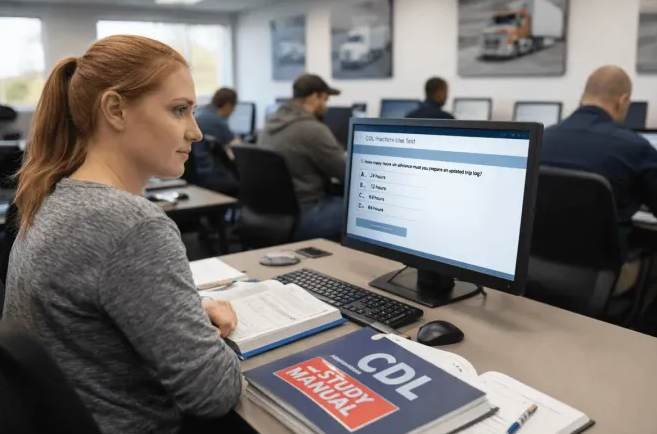
Days 11-14: Take timed practice tests online to simulate the real exam. The free CDL test questions and answers printable sheets build your knowledge, but you need screen practice to get comfortable with the DMV computer format.
Conclusion
These free CDL test questions and answers printable study sheets are built to help you print, review, and remember the most commonly tested CDL permit material fast. If you want CDL test questions and answers PDF style review, a printable CDL practice test, and a simple answer key workflow, this page gives you all three in one place.
Start with the key numbers, work through the General Knowledge section first, and then use online practice tests for timing and screen-format practice. That combination usually works much better than trying to memorize the handbook in one pass.
For more practice questions, try our Free CDL Practice Test for the full interactive experience. For the complete question bank, check our 100+ Real CDL Exam Questions. For a structured study plan, see our CDL Permit Test Study Guide.
Frequently Asked Questions (FAQ)
Can I print these CDL test questions to study offline?
Yes. This entire page is designed to be printer-friendly. Press Ctrl+P (or Cmd+P on Mac) in your browser to print all the questions, answers, and the key numbers table. No signup or download is required. The page formats cleanly on standard 8.5x11 paper.
How many questions are on the real CDL permit test?
Question counts vary by state. Federal standards require at least 30 questions on the basic knowledge test and at least 80% correct on general and endorsement knowledge tests. Confirm the current count in your state CDL manual.
What numbers do I need to memorize for the CDL test?
The most tested numbers: CDL GVWR threshold 26,001 lbs, Class A trailer 10,001+ lbs, governor cut-in 100 psi, cut-out 125 psi, safety valve 150 psi, low air warning 60 psi, spring brakes 20-45 psi, combination leak rate 4 psi/min, steer tire tread 4/32 inch, other tires 2/32 inch, BAC limit 0.04%, brake lag at 55 mph ~32 feet.
Is this printable guide enough to pass the CDL test?
This guide covers the most frequently tested topics and numbers, but it is not a complete replacement for your state CDL manual. Use these free CDL test questions and answers printable sheets alongside the official manual and interactive practice tests for comprehensive preparation.
Can I bring printed notes into the DMV testing center?
Do not bring notes or devices unless your licensing agency explicitly allows them. Testing-room rules and penalties are state-controlled, so follow the official appointment instructions.
How should I use printable study materials for CDL prep?
Print the materials and use active recall: cover the answers and try to answer each question from memory. Circle the questions you get wrong in red pen and review them daily. Once you consistently score 80% or higher on the printed questions, switch to timed online practice tests to simulate real exam pressure and get comfortable with the DMV computer format.