
Need to study offline? Press Ctrl+P (or Command+P on Mac) to save this page as your Texas CDL HazMat test questions and answers PDF study sheet. The placard table and practice questions below are formatted for clean printing so you can review them in the truck cab without cell service.
A Texas Hazardous Materials endorsement involves two separate jobs: proving knowledge of safe HazMat transportation and completing the federal security threat assessment. Not every trucking job requires H, so confirm the endorsement required by the work you plan to perform.
The order matters. Texas DPS says applicants may not initiate fingerprinting until they complete the HME application process at the driver license office.
This guide follows the current Texas DPS workflow and includes practice questions for the handbook material.
Step 1: Confirm Eligibility and Complete ELDT
Review the official Texas HME eligibility rules. First-time H endorsement applicants must also complete applicable theory training through an FMCSA-registered ELDT provider before the knowledge test.
Apply at a Texas Driver License Office
Submit the required CDL-1, Texas HazMat application CDL-6, medical certification and proof of citizenship or permanent residence at the driver license office. After submitting the application and state fee, take the HazMat knowledge exam. Use the official DPS page for the complete acceptable-document list.
IdentoGO Fingerprinting
After the DPS application step, Texas provides the vendor contact information and a service code. DPS currently directs applicants to IdentoGO for digital fingerprinting. Use that code to schedule the appointment.
What to bring:
- The Texas CDL specified by DPS
- The appointment and service-code information supplied after the DPS application
- Any identity documents the vendor requires for the appointment
The non-refundable vendor fee is subject to change. Confirm the current price and required documents while scheduling.
The Wait
TSA uses the fingerprints and submitted information for the security threat assessment. Texas DPS says TSA’s goal is to provide a response within 30 days of receiving the information and fingerprints; this is a goal, not a guaranteed completion date.
First-time applicants do not receive the H endorsement until TSA clearance is complete. Existing HME holders may receive the temporary treatment described on the official DPS page.
What Disqualifies You
The TSA denies HazMat applications for:
- Certain felony convictions within the past 7 years (violent crimes, weapons offenses, drug trafficking)
- Any terrorism-related conviction - lifetime ban
- Outstanding criminal warrants
- Dishonorable military discharge
- Being found mentally incompetent by a court
If you have a criminal record or immigration-status question, review the official eligibility and appeal material before paying a non-refundable fee. Do not rely on a simplified third-party list.
Step 2: Review the HazMat Handbook Material
Study the Hazardous Materials section of the current Texas DL-7C handbook.
For first-time H applicants, the registered ELDT provider reports theory completion to the federal Training Provider Registry. Verify the provider in the registry before paying.
- Provider check: Use a provider listed in the FMCSA Training Provider Registry.
- Price and schedule: These are set by the provider; Texas DPS does not publish one universal course price or duration.
- Verification: Confirm the completion appears in the federal registry before visiting DPS for the H knowledge test.
Do not assume an emailed course certificate alone is sufficient; the required record must be available for electronic verification.
Step 3: The Texas CDL HazMat Test
Complete the DPS application and follow the office’s appointment instructions. First-time H applicants need applicable ELDT verified before the HazMat knowledge test; TSA clearance is required before the endorsement can be issued.
Test format:
- Passing standard: 80% or better on each knowledge test under the current handbook
- Source: Hazardous Materials material in the current Texas commercial driver handbook
- Format: DPS controls the live test format and does not guarantee a fixed public question count or time limit for every session
The test covers four topic areas: Containment (packaging), Communication (placards, labels, shipping papers), Loading and Unloading (segregation), and Driving Rules (railroad crossings, parking, tire checks).
The 1,001-Pound Rule: Table 1 vs Table 2
This is the most-tested topic on any Texas CDL HazMat test. The DMV will ask you about it in at least 3 or 4 different ways.
| Placard Table | When to Placard | Common Materials |
|---|---|---|
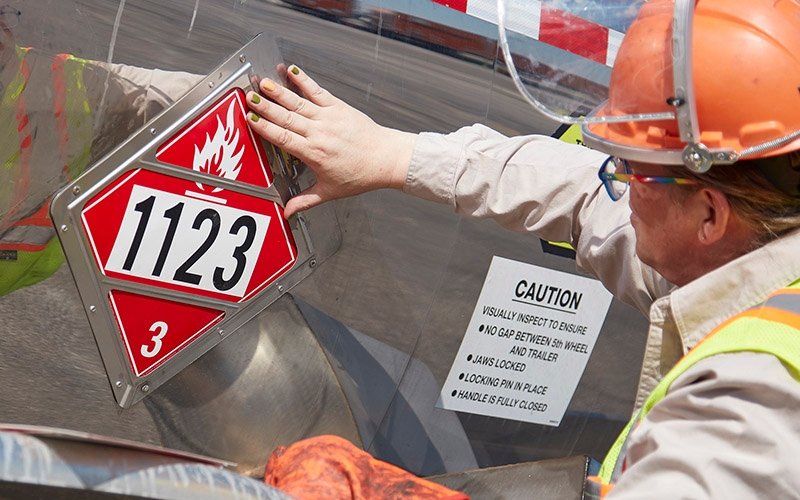
| Table 1 | ANY amount. Even 1 pound. | Explosives 1.1 / 1.2 / 1.3, Poison Gas 2.3, Dangerous When Wet 4.3, Organic Peroxide 5.2 (Type B), Radioactive Yellow III |
| Table 2 | 1,001 lbs or more (aggregate) | Flammable Gas 2.1, Flammable Liquid 3 (gasoline, diesel, crude oil), Oxidizer 5.1, Corrosive 8 (battery acid) |
Practice scenario: compare a Table 2 Class 3 load below the aggregate threshold with a Table 1 material. The correct decision depends on the exact material, quantity, packaging and exceptions—not on the fact that the trip happens in Texas.
Energy-sector drivers should verify the proper shipping name, hazard class, quantity and packaging on the shipping papers instead of assuming that every petroleum load is handled identically.
Applying HazMat Rules to Texas Energy Work
The Permian Basin and Gulf Coast create many HazMat and tank-vehicle jobs, but the federal communication, loading, segregation and driving rules still depend on the material and vehicle involved.
Crude oil loading and unloading:
- Confirm the shipping description, placarding table and quantity on the documents for the actual load.
- Follow the facility’s loading, bonding, grounding and attendance procedures plus the handbook rule for that material and packaging.
- Apply smoking and ignition-source restrictions exactly where the handbook requires them.
Waiting time at well sites:
- Hours-of-service status depends on the driver’s actual duties and freedom from work, not simply the name of the location.
- Follow the carrier’s compliant logging procedure and current FMCSA rules for the specific operation.
Tank vehicle requirements:
- A driver may need both Tank Vehicle (N) and HazMat (H) privileges when the vehicle and load meet both endorsement definitions.
- The combined Tanker and HazMat endorsement is shown as X.
Texas CDL HazMat Practice Test: 10 Questions
These original study questions apply handbook concepts; they are not copied from or represented as live DPS questions.
Emergency responders must find shipping papers instantly if you are unconscious or away from the truck. The driver's seat or door pouch are the only acceptable locations. Never in the glove box, never in the trailer.
Poison Gas 2.3 is a Table 1 material. Table 1 requires placards at any quantity, even 1 pound. Class 3 and Class 8 are Table 2 materials that only require placards over 1,001 lbs.
Crude oil is Class 3 Flammable Liquid, a Table 2 material. The 1,001-pound rule applies. At 1,200 lbs you are over the threshold. Placards are required on all four sides. Crude oil is not exempt from any placard rules.
You must ground and bond the cargo tank to the loading facility before any flammable transfer. This eliminates static electricity buildup that could ignite vapors. This is a critical safety procedure in Texas oil field operations.
Stop between 15 and 50 feet before the nearest rail. Turn on your 4-way flashers. Open the window and door. Look and listen. Do not shift gears while crossing. Texas has thousands of rail crossings, and this rule applies to all HazMat loads.
Cyanides and acids react to produce hydrogen cyanide gas, which is lethal. This segregation rule is absolute - no dividers, no distance separation, no exceptions. They cannot be in the same trailer.
Division 1.1, 1.2, and 1.3 explosives require a 300-foot buffer from any structure or gathering of people. This is a hard number that shows up on virtually every **CDL HazMat practice test Texas** students take.
Check tires at every stop, or every 2 hours / 100 miles. A hot or underinflated tire on a HazMat load can cause a fire that is impossible to extinguish. This is one of the strictest inspection intervals in CDL regulations.
A placarded vehicle must carry a fire extinguisher with a UL rating of at least 10 B:C. It must be fully charged, accessible, and inspected regularly.
The shipper handles all packaging, labeling, and shipping paper preparation. The driver verifies the load is properly secured, placards are correct, and papers are in order before driving.
How to Score Your Practice Test
Count correct answers out of 10:
| Score | Readiness | Next Step |
|---|---|---|
| 90-100% | Ready | Book your DPS appointment |
| 80-89% | Almost | Review wrong answers, retake in 2 days |
| 70-79% | Not yet | Study your weakest section in the manual |
| Below 70% | Need work | Re-read Section 9 of the Texas CDL manual |
The handbook’s passing threshold is 80%. Aim higher on practice so unfamiliar wording does not push the result below the official standard.
Need to study on the go? Press Ctrl+P to save this page as your Texas CDL HazMat test questions and answers PDF and keep it on your phone for offline review.
The Complete Process: How to Get Your HazMat in Texas
Follow this verified order:
- Confirm Texas HME eligibility.
- Complete first-time H endorsement ELDT through a registered provider when applicable.
- Visit a Texas driver license office with the required forms and documents, submit the HME application and fee, and take the knowledge test.
- Use the DPS-provided service code to schedule vendor fingerprinting and confirm the current non-refundable vendor fee.
- Complete fingerprinting and retain the tracking information.
- Wait for TSA’s assessment and Texas issuance. First-time applicants do not receive H until clearance is complete.
Total cost and completion time vary. Texas DPS publishes state license fees separately; training and fingerprint-vendor charges can change.
Conclusion
The Texas CDL HazMat test is not something you can wing. The placard rules are specific, the TSA background check takes weeks, and the DPS exam asks layered questions that combine hazard classes, weight thresholds, and segregation rules in a single scenario.
Use this Texas CDL HazMat practice test to find weak spots, then verify every missed answer in the current handbook. Do not reverse the Texas process by starting fingerprinting before the DPS HME application.
For more preparation, try our Free CDL Practice Test with additional HazMat questions. Check our HazMat Practice Test guide for the full 30-question practice exam, and our CDL HazMat Study Guide for the complete breakdown of the 9 hazard classes and TSA process.
Frequently Asked Questions (FAQ)
How do I schedule HazMat fingerprinting in Texas?
Complete the HME application at a Texas driver license office first. DPS then gives you the fingerprint vendor information and service code. Use it to schedule with the current vendor and confirm the current fee and document list.
Can I take the Texas CDL HazMat test online?
No. The ELDT theory course can be completed online through an FMCSA-approved provider, but the actual Texas CDL HazMat test must be taken in person at a Texas Driver License Office. You cannot take the written knowledge exam from home.
How many questions are on the Texas CDL HazMat test?
The current Texas handbook requires 80% or better on each knowledge test. Study its Hazardous Materials section; DPS does not guarantee a fixed public question count for every session.
Can I print the Texas CDL HazMat test questions and answers as a PDF?
Yes. Press Ctrl+P (or Command+P on Mac) to save this page as a Texas CDL HazMat test questions and answers PDF. The placard table and practice questions are formatted for clean printing so you can study offline in the truck cab.
What disqualifies you from getting a HazMat endorsement in Texas?
Eligibility depends on the complete federal and Texas rules, including the type and timing of an offense and any waiver or appeal rights. Use the official Texas HME page and TSA material rather than a shortened list on a prep site.
Do I need ELDT training for the HazMat endorsement in Texas?
Yes. First-time H endorsement applicants must complete the applicable HazMat theory curriculum through a provider listed in the FMCSA Training Provider Registry before the knowledge test. Provider price and duration vary.
Official Sources
- Texas DPS Hazardous Materials Endorsement process
- Texas HazMat application CDL-6
- Texas Commercial Motor Vehicle Drivers Handbook
- FMCSA Entry-Level Driver Training