

The cdl hazmat test is different from the other CDL exams because one question can test several rules at once: hazard class, placard table, weight threshold, shipping papers, and segregation. This free cdl hazmat practice test gives you 12 exam-style questions with answers and explanations, plus a short placard drill for the topic most drivers miss.
Use it like a real cdl hazmat practice exam: set a timer for 20 minutes, answer every question before checking the explanations, then use the score chart below to decide whether you are ready for the DMV.
CDL HazMat Test Quick Facts
| Item | What to Know |
|---|---|
| Test length | Set by your licensing state; verify the current state manual |
| Passing score | At least 80% under federal standards |
| Main topics | Placards, labels, shipping papers, loading, unloading, containment, driving rules |
| Most-tested area | Communication: placards, labels, and shipping papers |
| Extra requirement | TSA Security Threat Assessment before the endorsement is issued |
Full app practice
Want the full HazMat test experience? This free page gives you a quick 12-question warm-up. The CDL PassMaster app gives you 150+ HazMat questions, timed practice, instant explanations, and repeatable tests until you are ready.
Take the Free HazMat Diagnostic →Free CDL HazMat Practice Test: 12 Sample Questions
These 12 questions cover placards and shipping papers first, then loading, driving, and containment. Cover the answers, work through each one honestly, and check your results at the end. For a fresh baseline rather than repeated questions, use the HazMat diagnostic linked above.
Emergency responders must find your shipping papers immediately if you are unconscious. The door pouch or driver's seat are the only acceptable locations. Never in the glove box or trailer.
Poison Gas 2.3 is a Table 1 material. Table 1 requires placards at any quantity - even 1 pound. The 1,001-pound rule only applies to Table 2 materials. This is the most common trap on the **cdl hazmat test**.
Both Class 3 and Class 8 are Table 2 materials. The rule says you add up ALL Table 2 HazMat weight. 800 + 400 = 1,200 lbs, which exceeds 1,001 lbs. Placards are required for both classes on all four sides.
Cyanides mixed with acids produce hydrogen cyanide gas. This segregation rule is absolute - no dividers, no distance separation, no exceptions. They cannot be in the same trailer, period.
The shipper packages, labels, and prepares the shipping papers. The driver's responsibility is to verify the load is properly secured, the placards match, and the shipping papers are correct before driving.
Division 1.1, 1.2, and 1.3 explosives require a 300-foot buffer from any bridge, tunnel, dwelling, or assembly of people. This is a hard number that shows up on virtually every **cdl hazmat endorsement test**.
Stop between 15 and 50 feet before the nearest rail. Look both ways. Listen. Do not shift gears while crossing. This rule applies to all HazMat loads, not just explosives.
Check tires at every stop, or every 2 hours / 100 miles, whichever comes first. Heat buildup from underinflated tires on a HazMat load can cause a fire that cannot be extinguished. This is one of the strictest inspection intervals in all CDL regulations.
A placarded HazMat vehicle must carry a fire extinguisher with a UL rating of at least 10 B:C. It must be accessible, fully charged, and inspected regularly.
The Transport Index (TI) measures radiation level at 1 meter from a radioactive package. It determines spacing requirements - how close the package can be to other cargo, people, and vehicle walls. Higher TI means more distance required.
Materials labeled "Inhalation Hazard" require a POISON INHALATION HAZARD placard in addition to the standard class placard. This is a specific federal requirement that appears frequently on the **cdl hazmat endorsement test**.
No smoking or carrying lighted materials within 25 feet of a placarded vehicle carrying flammables, explosives, or oxidizers. This applies to anyone near the truck, not just the driver.
How to Score Your Practice Test
Count your correct answers out of 12, then use this scale:
| Score | Readiness | What to Do |
|---|---|---|
| 90-100% | Ready | Book your DMV appointment |
| 80-89% | Almost | Review wrong answers, retake in 2 days |
| 70-79% | Not yet | Focus study on your weakest section |
| Below 70% | Need work | Re-read the HazMat chapter before more testing |
The passing threshold on the real cdl hazmat endorsement test is 80%. But on your cdl hazmat test practice at home, aim for 90%. The actual exam adds time pressure and different question wording that will cost you points.
Your score identified the gap
Missed 3 or more questions, or guessed on any answer? Unlock the complete CDL app for broader HazMat coverage, explanations, mock exams, and weak-area practice across the full 1,500+ question bank.
Unlock Full Practice — $19.99 One-Time →HazMat Placard Practice Test
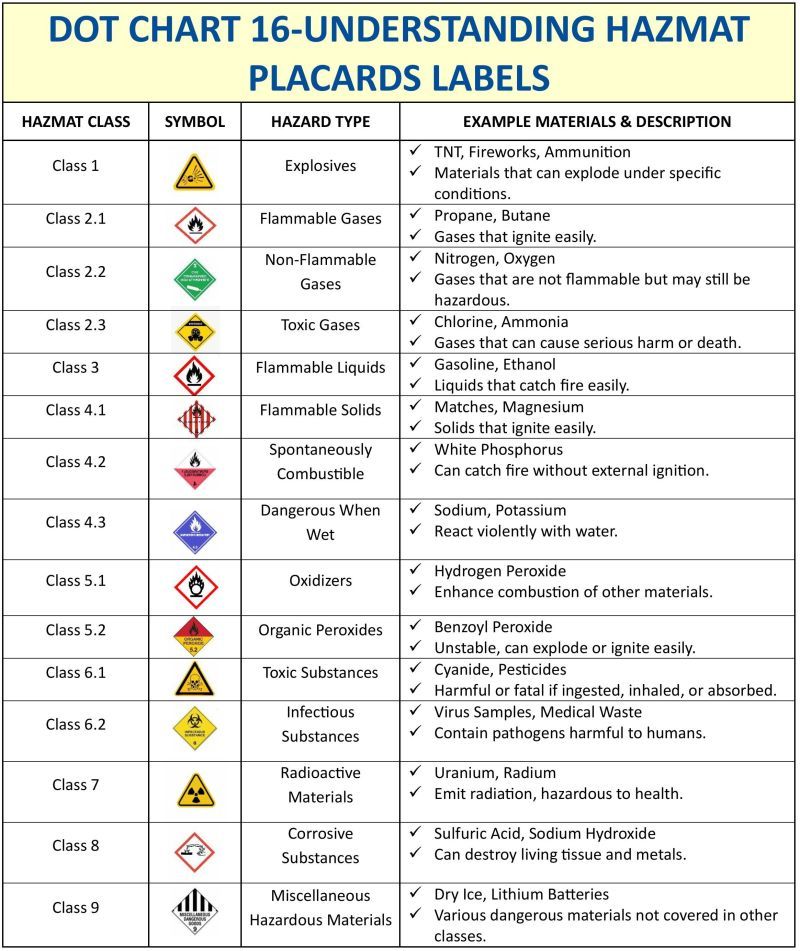
Placards are the single most-tested topic on any cdl hazmat test, so it pays to drill them on their own. These four placard questions target the rules people miss most. Take this hazmat placards test after the main quiz to lock in the diamond rules.
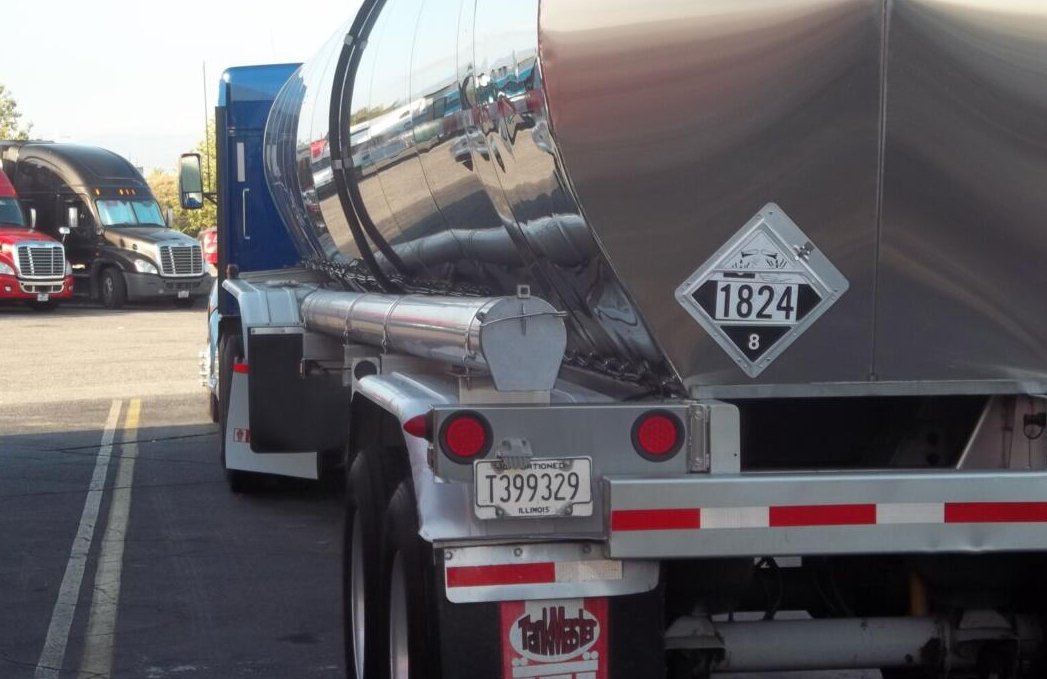
HazMat placards are diamonds (squares set at a 45-degree angle) and must be at least 10.8 inches (273 mm) on each side. The shape itself signals "hazardous material" to emergency responders from a distance.
A placarded vehicle needs four placards: front, rear, and both sides. They must be readable from every direction and never covered by mud, tarps, or other equipment.
You may use one DANGEROUS placard for two or more Table 2 materials from different classes. But if 2,205 lbs (1,000 kg) or more of one class is loaded at one place, you must show that class's specific placard instead.
A subsidiary hazard label means the material poses a second risk on top of its primary class. You must consider both hazards for placarding and especially for segregation - a flammable that is also corrosive cannot ride next to incompatible cargo.
Key Rule: Table 1 vs Table 2 Placards
The 1,001-pound rule is one of the biggest traps on any cdl hazmat endorsement practice test. First identify the material table, then check the weight.
| Placard Table | When to Placard | Common Materials |
|---|---|---|
| Table 1 | ANY amount. Even 1 pound. | Explosives 1.1 / 1.2 / 1.3, Poison Gas 2.3, Dangerous When Wet 4.3, Radioactive Yellow III |
| Table 2 | 1,001 lbs or more | Flammable Gas 2.1, Non-Flammable Gas 2.2, Flammable Liquid 3, Oxidizer 5.1, Corrosive 8 |
Example: 800 pounds of Class 3 Flammable Liquid does not need placards because Class 3 is Table 2 and the load is under 1,001 pounds. But 800 pounds of Poison Gas 2.3 does need placards because Poison Gas is Table 1.
What Is on the HazMat Endorsement Test?
The official cdl hazmat endorsement test has 30 multiple-choice questions. Counts vary by state, but the test usually leans hardest on placards, labels, shipping papers, and loading rules.
| DMV Topic | What It Covers | Common Test Trap |
|---|---|---|
| Communication | Placards, labels, shipping papers | Where papers must be kept; when placards are required |
| Loading and unloading | Segregation and attendance rules | Cyanides with acids; explosives with detonators |
| Driving and parking | Railroad crossings, tire checks, parking distance | 15-50 ft at rail crossings; 300 ft for explosives |
| Containment | Packaging, leaks, cargo tanks | Shipper vs driver responsibilities |
For a deeper rule-by-rule review, use the CDL HazMat Study Guide. This page is meant to help you practice and check readiness quickly.
Study Strategy
Take this cdl hazmat sample test cold first. Then review every missed question and group your mistakes by topic: placards, shipping papers, loading, driving rules, or containment.
After that, take a full-length test under timed conditions. Keep practicing until you can score 90% twice in a row; the DMV only requires 80%, but test-day wording and nerves can cost points.
Printable HazMat Practice Test (with Answers)
Prefer to study away from a screen? Print this page and you will get all 16 questions: the 12-question quiz, the placard drill, and every answer explanation.
- On desktop: press Ctrl + P (Windows) or Cmd + P (Mac), then choose “Save as PDF” or print.
- On phone: open your browser menu and tap Share → Print, then save as PDF.
For unlimited fresh question sets instead of the same printed page, use the full HazMat simulator.
Conclusion
This free cdl hazmat practice test is a fast way to find your weak spots before the DMV exam. If you missed placard or shipping paper questions, review Table 1 vs Table 2 and then take more cdl hazmat test practice until the rules feel automatic.
For more preparation, try our Free CDL Practice Test, our CDL Permit Test Study Guide, and the full CDL HazMat Study Guide.
Frequently Asked Questions (FAQ)
How many questions are on the CDL HazMat endorsement test?
Your state sets the HazMat question count. Federal standards require at least 80% correct on endorsement knowledge tests, so use your state manual for the current test length and local retest rules.
Is this CDL HazMat practice test free?
Yes. This free cdl hazmat practice test includes 12 exam-style questions plus 4 placard questions, all with explanations.
What score do I need to pass the HazMat test?
The DMV passing score is normally 80%. On any cdl hazmat practice exam, aim for 90% before booking your appointment.
What is the difference between Table 1 and Table 2 placards?
Table 1 materials require placards at any quantity. Table 2 materials usually require placards only when the aggregate weight is 1,001 pounds or more.
How should I use a CDL HazMat sample test to study?
Take a cdl hazmat sample test first, review missed questions, then study the matching HazMat manual sections. Retake practice tests until you score 90% consistently.
Do I need a TSA background check for the HazMat endorsement?
Yes. HazMat applicants must pass a TSA Security Threat Assessment with fingerprinting and a federal background check before the endorsement can be issued.
Official sources
- FMCSA state CDL knowledge-test standards
- FMCSA Entry-Level Driver Training
- TSA HazMat endorsement enrollment