
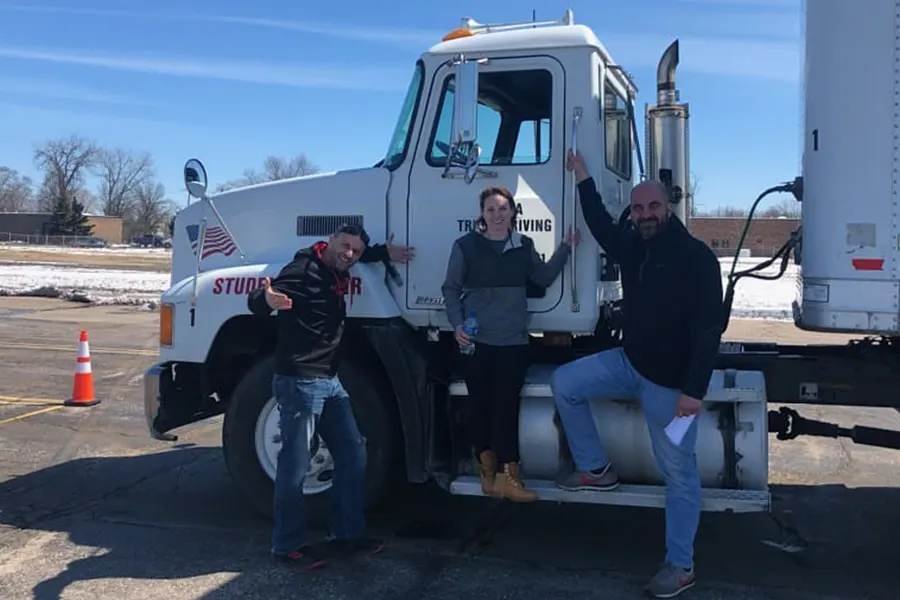
Most people who fail a Michigan CDL knowledge test do not fail because the material is impossible. They fail because they read the whole Michigan CDL manual like a novel, burn out somewhere in the doubles and triples chapter, and walk into a Secretary of State office knowing a lot about school buses and not enough about air brakes.
Michigan is unusually direct about what the book is for. The Secretary of State tells every applicant to use the Commercial Driver License Manual as the study guide, because the knowledge tests and the skills test are drawn from it. Read the sections your license group needs and skip the ones it does not, and the terminal stops being intimidating.
This guide maps the Michigan CDL manual to your actual goal: what the book covers, which chapters each license group and endorsement require, how the SOS administers the tests, what the chauffeur license wrinkle means, and a four-week study plan that fits around a job.
What the Michigan CDL Manual Actually Is
The official book is the Michigan Commercial Driver License Manual, form SOS-116, published by the Secretary of State. You download it free from michigan.gov/sos, chapter by chapter, which matters more than it sounds: you can print the five sections a Group A applicant needs instead of hauling a 200-page document around.
The manual follows the federal section layout used across most states:
- Section 1, Introduction: license groups, endorsements, disqualification rules.
- Section 2, Driving Safely: the biggest chapter and the source of most general knowledge questions.
- Sections 3 through 10: cargo, passengers, air brakes, combination vehicles, doubles and triples, tank vehicles, hazardous materials, and school buses, each tied to an endorsement or vehicle type.
- Sections 11 through 13: pre-trip inspection, basic control skills, and the road test, the chapters your skills test is scored against.
Michigan adds its own state material on top. The book covers the chauffeur license rules unique to Michigan, the farm F endorsement, and a Truckers Against Trafficking section the state includes for awareness. Those pages explain Michigan paperwork the federal chapters do not touch.
Which Michigan CDL Manual Sections You Need by Goal
The Secretary of State structures its tests around license groups, and the group you want decides which chapters matter. Here is the cut-down map:
| Your goal | Knowledge tests required | Manual chapters to study |
|---|---|---|
| Group A, air brakes | General, combination, air brakes | Sections 1, 2, 3, 5, 6, plus 11-13 for skills |
| Group B, straight truck | General, air brakes if equipped | Sections 1, 2, 3, 5, plus 11-13 |
| Group C, passenger or HazMat | General plus P or H material | Sections 1, 2, 3, 4 or 9, plus 11-13 |
| Tanker endorsement | N test, 20 questions | Section 8 |
| Doubles/triples endorsement | T test, 20 questions | Section 7 |
| School bus endorsement | S test, 20 questions | Section 10 |
A Group A applicant with air brakes needs roughly half the book. The other half exists for drivers with different goals, and reading it anyway is the single most common way applicants run out of gas before test day.
Group A means a combination vehicle, so the 20-question combination test stacks on top of the 70-question general test, and any air-brake-equipped vehicle adds the 25-question air brakes test. Endorsement tests like tanker and school bus only exist if you add those endorsements.
How the SOS Tests You on the Manual
Knowledge tests happen at a computer station in a Secretary of State office, and every one of them has the same pass line: 80 percent. Michigan publishes its question counts, which most states do not, so you can walk in knowing exactly what is coming:
| Test | Questions | Who takes it |
|---|---|---|
| General knowledge, Group A | 70 | Group A applicants |
| Combination vehicles | 20 | Group A applicants |
| General knowledge, Group B or C | 50 | Group B and C applicants |
| Air brakes | 25 | Anyone testing in an air-brake-equipped vehicle |
| Hazardous materials | 30 | H endorsement seekers |
| Tanker, passenger, school bus, doubles/triples | 20 each | The matching endorsement |
Two scheduling rules shape your whole timeline. You may attempt one test per category per day, and after a failed test you wait one day before retaking it. Fail the 70-question Group A general test on a Friday and the earliest retake is Sunday, with the queue at the office deciding whether that even happens. Preparation is cheaper than rescheduling.
The skills side has its own trap: if your test vehicle has air brakes and you skip the air brakes knowledge test, or you test in a vehicle without them, your CDL carries an air brake restriction. Since most entry-level trucking jobs put you in an air-brake-equipped tractor, plan to test in one.
Chauffeur License or CDL: Michigan’s Two-Track Rule
Michigan is one of the few states with a second commercial-style license running parallel to the CDL, and the manual explains the split:
- Chauffeur license: required when you are employed to drive and the vehicle or combination is rated at 10,001 pounds or more GVWR or GCW. Delivery trucks, service trucks, small straight trucks for hire.
- CDL: required at 26,001 pounds GVWR, for vehicles designed to carry 16 or more passengers, or for placarded hazardous materials.
The two are not separate wallets. Michigan issues CDL groups and endorsements as additions onto your chauffeur license, so the upgrade path is one license document, not two. There is also an F endorsement for farm combinations: a knowledge test only, not a CDL, valid within 150 miles of the farm that operates the vehicle.
Age rules mirror federal law: 18 to start, but 18 to 20 means Michigan-only driving, and 21 for interstate work and hazardous materials. One more state quirk worth knowing early: triple trailers are prohibited on Michigan roads, so the doubles and triples chapter is real, but the triples part of it is not a Michigan career path.
Employment plus a rating over 10,000 pounds triggers the chauffeur license. The CDL line starts at 26,001 pounds, or 16 passengers, or placarded HazMat. Plenty of Michigan drivers hold a chauffeur license for years before ever needing a CDL.
From Manual to License: The SOS Process in Order
The manual sits inside a process, and the order protects your timeline:
- Confirm eligibility. You need a valid Michigan license, legal presence, and a Social Security number. HazMat seekers also need proof of a Security Threat Assessment before the endorsement issues.
- Pass the knowledge tests and vision screening at a Secretary of State office, 80 percent each, one test per category per day.
- Pay and get your CLP. A Commercial Learner Permit lets you drive the class of vehicle you tested for, with a properly licensed CDL holder in the front seat.
- Hold the CLP 14 days minimum, logging supervised practice. If HazMat is the goal, complete hazmat ELDT theory before the H knowledge test, not after.
- Book the skills test with a state-approved driver testing business, at least two days ahead. The SOS does not run skills tests itself, and it does not set the fees either.
- Pass pre-trip, basic control, and the road test in a representative vehicle. Results stay valid one year.
- Return to a Secretary of State office to finish: $5 per endorsement and a $9 correction fee upgrade the license, you leave with a temporary permit, and the photo CDL arrives by mail, $18 standard or $33 enhanced.
Two process shortcuts exist. Veterans can apply for a Military Waiver Even Exchange to skip the skills test with qualifying experience. And if you drop an endorsement, adding it back within two years requires no new exam, a grace period worth remembering.
Since November 2024, every CDL application also runs through the federal Drug and Alcohol Clearinghouse, so resolve any registration holds before you book anything.
What a Michigan CDL Costs in 2026
| Item | Fee |
|---|---|
| License correction (upgrade to CDL) | $9.00 |
| Each endorsement added | $5.00 |
| New photo CDL | $18.00 |
| Enhanced CDL (land and sea re-entry) | $33.00 |
| Skills test (state-approved tester) | Set by each testing business |
| DOT physical (private examiner) | $80 - $150 typical |
| ELDT theory (online, HazMat or entry level) | $30 - $100 typical |
The Secretary of State side is under $40 even with an endorsement or two, which is among the cheapest state paperwork in the country. The real variables are the tester’s skills fee, which you should ask about when booking, and training, which the full CDL cost breakdown covers route by route, including the company-sponsored contracts our paid CDL training guide evaluates.
The Michigan job market backs the effort. Detroit’s automaking and parts logistics, the I-75 and I-94 freight corridors, and the Port of Detroit all hire Class A and B drivers year-round, and the DOT physical requirements guide covers the medical readings that surprise people first.
A 4-Week Michigan CDL Manual Study Plan
| Week | Focus | Milestone by Sunday |
|---|---|---|
| 1 | Sections 1 and 2, one pass each | 70 percent or better on a general knowledge practice test |
| 2 | Section 3 plus the air brakes chapter | 80 percent on general knowledge, start air brakes questions |
| 3 | Combination vehicles if Group A, ELDT theory if HazMat | All practice scores at 85 percent, theory done |
| 4 | Pre-trip memorization, weak-number review | Book the SOS visit and the skills tester |

The plan assumes about an hour a night. Compress it by doubling up, but do not stretch it: the one-test-per-day rule means every failed attempt costs you at least two calendar days, and skills testers book out days in advance.
For drilling, study a section, then test on it, and log the topics you miss rather than the questions. Start with our free CDL practice test for a baseline, move to the CDL general knowledge practice test mid-manual, then finish exam week with the air brakes cheat sheet. Michigan-specific drilling lives in our Michigan CDL practice test guide, and the question bank behind the real thing is covered in Michigan CDL test questions and answers. Do not book the SOS visit until you clear 85 percent twice on separate days.
Scoring at the pass line means one bad number question or a rough morning sinks a 70-question Group A attempt, and Michigan's one-day wait plus one-test-per-day rule turns that into lost days. The 5-point cushion is the cheapest insurance in the process. Option C is the exact trap this guide exists to stop.
Michigan Rules That Catch New Drivers
Five state-specific realities worth knowing before you book anything:
- One test per category per day. You cannot bundle a failed morning retake into the afternoon. Schedule knowledge tests you are ready for, not ones you hope to pass.
- Air brakes are a vehicle decision, not a paper decision. Test without an air-brake-equipped vehicle and your CDL carries a restriction most employers will not accept.
- Skills testers set their own fees and calendars. The SOS certifies the businesses but does not run them, so the two-day booking minimum is a floor, not a promise.
- Skills results expire in a year. Pass, then let life happen for fourteen months, and you are retesting. Pair the skills pass with your SOS visit.
- Endorsements have a two-year grace window. Drop one and re-add it inside two years with no exam. Past that, it is a new test and a new fee.
Conclusion
The Michigan CDL manual is free, official, and honest about its job: the Secretary of State builds every knowledge test and the skills test from it. The failure mode is never the book, it is reading all of it. A Group A applicant with air brakes needs the core sections plus two chapters, the endorsement material can wait, and the one-test-per-day rule rewards walking in over-prepared instead of casually optimistic.
The wrap-up: 80 percent to pass, 70 plus 20 questions for Group A, a chauffeur license threshold at 10,001 pounds, under $40 in SOS fees, and a skills tester you book two days out. Work the four-week plan, clear 85 percent twice, and the terminal stops being a threat.
Next step: run our Michigan CDL practice test and requirements guide for the full CLP-to-license process, check which CDL class fits the job you actually want, and keep the pre-trip inspection checklist bookmarked for skills week. If your job sits below the federal CDL thresholds, use the separate Michigan chauffeur license vs CDL comparison before paying for training.
Frequently Asked Questions
Is the Michigan CDL manual free? Yes. The Michigan Commercial Driver License Manual, form SOS-116, is a free download from michigan.gov/sos, offered chapter by chapter so you can print only the sections your license group requires. The Secretary of State tells you outright to use it as your study guide, because the knowledge tests and the skills test are built from it. Never pay a third party for the book itself.
How many questions are on the Michigan CDL knowledge tests? Group A general knowledge is 70 questions plus a 20-question combination vehicles test, Group B and C general knowledge is 50 questions, the air brakes test is 25 questions, the HazMat test is 30 questions, and the tanker, passenger, school bus, and doubles/triples tests are 20 questions each. Every test requires 80 percent to pass, and you may attempt only one test per category per day.
What score do I need to pass Michigan CDL tests? Eighty percent on every knowledge test, taken at a computer station at a Secretary of State office. If you fail, you wait one day before retaking, and you can only take one test per category per day, so a failed 70-question Group A attempt costs you at least two calendar days of schedule.
Do I need a chauffeur license or a CDL in Michigan? If you are employed to drive and the vehicle or combination is rated at 10,001 pounds or more, Michigan requires a chauffeur license. You need a full CDL at 26,001 pounds GVWR, for vehicles carrying 16 or more passengers, or for placarded hazardous materials. Michigan adds CDL groups and endorsements onto your chauffeur license rather than issuing a separate document, and a farm F endorsement covers combinations controlled by a farm operator within 150 miles of the farm.
How much does it cost to get a CDL in Michigan? The Secretary of State side is modest: $9 as a correction fee when you upgrade your license, $5 per endorsement, $18 for the new photo CDL, or $33 for an enhanced CDL valid for land and sea re-entry into the United States. Skills test fees are not set by the SOS, each state-approved driver testing business charges its own rate, so ask when you book. The DOT physical typically runs $80 to $150 and online ELDT theory runs $30 to $100.
How long are Michigan CDL test results valid? Skills test results stay valid for one year. If you drop an endorsement, you can add it back within two years without testing again, but past that window you retake the exam. Plan your skills test and your SOS visit close together so nothing expires while paperwork moves.